%20(1).png)
%20(1).png)
Home
Five Kingdoms. One High Throne.
" The throne does not make the man. It only reveals him. "
— Roderin the IV
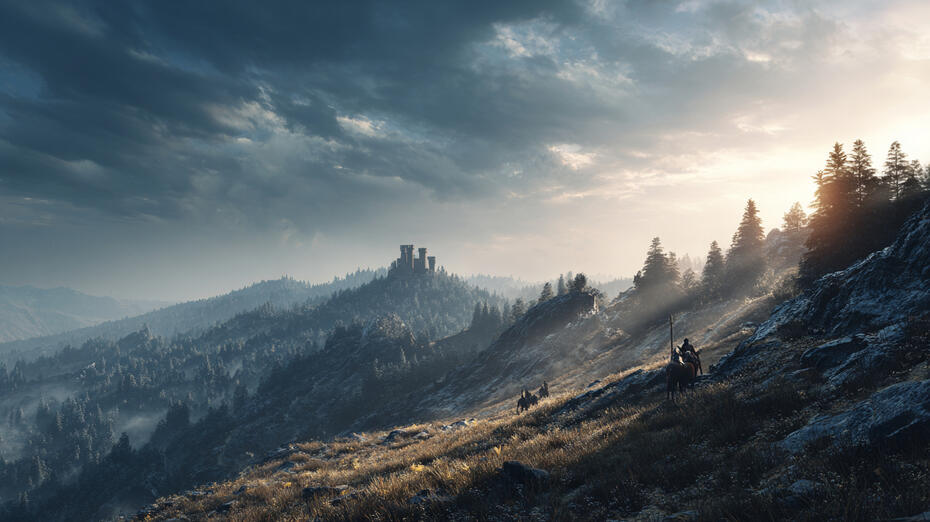
Five Great Kingdoms: Averon is a high-fantasy political epic set on the continent of Averon, a land shaped by ancient crowns, fractured oaths, and the long shadow of a fallen Old Kingdom. It is the primary narrative framework of the Averon setting and serves as the central installment of its wider mythos.The saga chronicles the rise and fall of monarchs, the shifting balance between law and blood, and the enduring consequences of the Sundering of Crowns, an event that shattered imperial unity and gave birth to five sovereign realms. The narrative places equal weight on courtly intrigue, dynastic conflict, and grounded human cost, with particular emphasis on legitimacy, succession, and the burden of rule in a world where history is weaponized as often as steel.Though bound by shared ancestry and trade, the kingdoms are divided by precedent, memory, and ambition, with no true High King having ruled all of Averon for over a thousand years.
Premise
A thousand years after the fall of the last true High King, Averon has learned to survive without unity—but not without consequence. The Five Great Kingdoms endure through law, precedent, and guarded alliances, each ruled by crowns that remember the Old Kingdom only as a piece of history. In a land where crowns are remembered as much for the blood they spilled as the order they imposed, the return of a High King may either bind the realm at last—or shatter it beyond repair.
Overview
The series is set on the continent of Averon, a land once ruled as a single empire under the Old Kingdom, before its collapse in the Sundering of Crowns over a thousand years before the series begins. In the aftermath of that fall, Averon fractured into five sovereign kingdoms, each governed by its own crown, laws, and noble hierarchies, bound together only by precedent, trade, and the shared memory of a unity that ultimately failed. For centuries, the absence of a High King has been treated not as a wound, but as a safeguard against tyranny, allowing the kingdoms to endure in a tense but stable balance.That balance begins to unravel with the events of 1102 ASC, when a massacre in the Northern Reaches annihilates the Beorthean royal line and leaves King Cassian Beorthean crowned amid grief rather than ceremony. Across the realm, lords, heirs, and sworn men alike find themselves drawn into conflicts of loyalty.As tensions rise within and between the kingdoms, the cost of this shifting order is borne not only by kings and princes, but by those sworn to serve them—knights, guards, and minor houses whose lives are reshaped by decisions made far above them. With banners beginning to stir and ancient obligations reawakened, Averon stands on the edge of either forced unity or renewed fragmentation. Five Great Kingdoms: Averon unfolds as a sweeping political epic in which the return of a High King may bring order to the realm—or repeat the very failures that once destroyed it.
More
The Great Empire: Averon is a high-fantasy imperial political epic set during the age of the Empire of Gyrok, when Averon is ruled not by divided kingdoms, but by the dragon-blooded authority of House Helyrion and the Dragon Throne. It serves as the imperial-era narrative framework of the Averon setting, exploring a continent bound beneath one empire through conquest, law, tribute, military roads, noble hostages, sacred blood, and the feared legacy of living dragons.
It is prequel to the Five Great Kingdoms: Averon series, and more can be read about it on the Gyrok Empire page.
Map of Averon & beyond
Includes both maps for FGK:A & TGE:A.
The Five Kingdoms Map
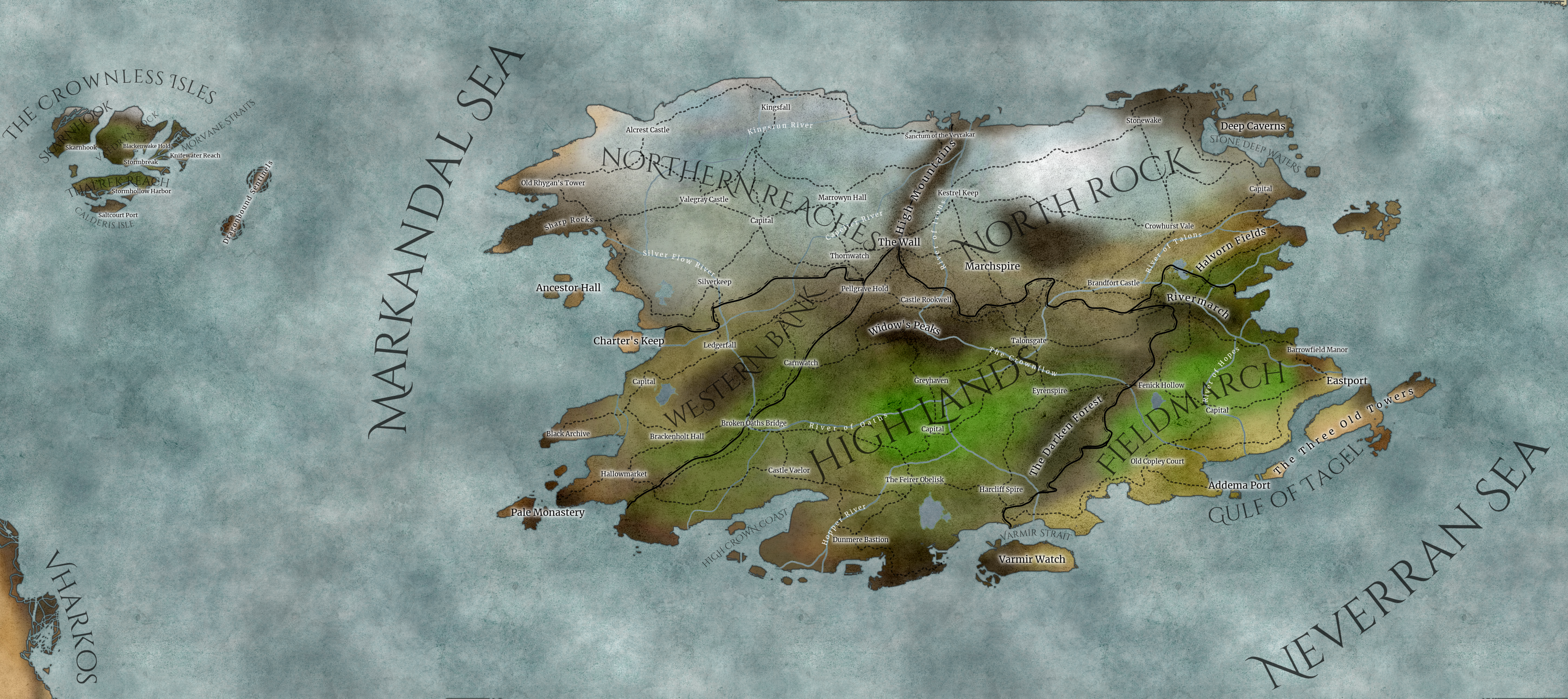
TRAVEL TIMES & ROADS OF AVERON
Most roads in Averon are stone-set only near capitals, major fortresses, royal seats, and the busiest ports; beyond those zones, they degrade into packed earth, gravel, timber-reinforced causeways, or deeply wagon-rutted tracks that become unreliable in rain, frost, or spring thaw. Old imperial milestones still survive along the oldest routes, especially near former Old Kingdom corridors, though many are cracked, half-buried, stripped for local building, or reused as border markers and gallows posts. Road quality is therefore a matter of proximity to power: the closer a traveler is to a capital, fortress city, toll artery, or major grain corridor, the more likely the road is to be passable in all seasons.• Travel speed assumes clear weather, lawful passage, no military obstruction, and no seasonal closures.
• Movement slows sharply under heavy rain, flood season, winter ice, spring mud, troop congestion, or active border scrutiny.
• Noble, military, and courier riders move faster than merchants or common travelers because they are more likely to have escorts, fresh mounts, and legal priority.Major Continental Routes• The Crownroad
The oldest surviving imperial road, running from the Northern Reaches south through the High Lands and continuing toward Fieldmarch, with its most important inland arteries passing through Kingsreach, Greyhaven, Highfall, Talonsgate, and the northern approaches to Wheaten. It remains the most symbolically important overland road in Averon, associated with old royal movement, military command, and state authority. Best maintained near capitals and fortified junctions, but less reliable in remote stretches. Travel: ~25–30 miles per day on foot, ~40 by horse under ideal conditions.• The Western Coastal Way
The primary coastal road of the Western Bank, running along the western littoral through commercial and administrative points tied to Ledgerfall, Charterfall, Hallowmarket, and the northern coastward routes linking back toward Silverkeep. It is heavily monitored, toll-marked, and legally controlled, with frequent inspections, charter checks, and customs delays. Though commercially essential, it is vulnerable to storms, washouts, coastal erosion, and smuggling interference. Travel: ~20 miles per day on average, often slower where toll and record scrutiny is strongest.• The Talonstride Route
The major inland corridor following the Talonstride River through Rivermarch, linking North Rock to Fieldmarch and serving as one of the most important strategic roads in the eastern half of the continent. Grain, troops, wagons, and military correspondence all move along this route, especially in times of war. Travel: ~30 miles per day when uncontested and in good seasonal condition.• The High Pass Roads
A network of narrow mountain approaches cutting through the High Mountains and the harder upland corridors between the Northern Reaches, North Rock, and the northern edges of the High Lands. These roads are fortified, exposed, and often deliberately restricted by local houses such as Kestrelmarch and Rookwell, with seasonal closure common in winter and early thaw. Travel: ~10–15 miles per day in good weather, often worse under military watch.• The River Oaths Road
The legal-commercial road approaching Broken Oaths Bridge and the River of Oaths, forming the principal overland connection between the Western Bank and the High Lands. Though not the oldest route, it is one of the most politically sensitive, as movement here passes through some of the most scrutinized customs and jurisdictional checks in the realm. Travel: ~20–25 miles per day, highly dependent on inspections and regional tension.• The Markandal North Road
The northern route linking Kingsfall, Kingsreach, Silverkeep, and the western interior roads, used for coastal supply, administrative movement, and military communication in the Northern Reaches. Though less grand than the Crownroad, it remains vital to northern cohesion. Travel: ~20–25 miles per day, weather permitting.River Travel
Rivers are the fastest lawful means of moving bulk goods, coin, timber, stone, and grain, but they are tightly regulated by toll houses, locks, noble jurisdictions, and seasonal water conditions.• Crownflow River: The main inland artery connecting the High Lands to Fieldmarch, especially important for food movement, irrigation control, and transport southward from the uplands.
• Silver Flow River: The principal trade river of the Western Bank, passing through Ledgerfall and tied closely to toll records, customs law, and charter verification.
• Talonstride River: A strategic river corridor linking North Rock to Fieldmarch through Rivermarch, heavily watched in wartime.
• Kingsrun River: The northern waterway descending toward Kingsfall, important for the old infrastructure of the Northern Reaches.
• Capelier River: A cold borderland river near Thornwatch, sustaining the southern reaches of the Northern Reaches and feeding traffic toward the Western Bank.• Barge travel can often double effective freight speed compared to roads, but river movement is slower in flood season, winter freeze, or where noble inspections halt passage.
• Bulk transport is cheaper by river, but legal stops are more controlled, more visible, and more easily taxed.Borders, Passes, and Delays
Crossing between kingdoms almost always incurs delay, cost, or scrutiny. Travelers may face:• Toll checks at bridges, ports, and major roads.
• Ledger verification, especially in the Western Bank, where legal passage may depend on stamped documentation, declared cargo, and recognized identity.
• Armed inspection near North Rock approaches, especially along marcher roads and pass entries.
• Ideological or ceremonial scrutiny near High Lands roads, particularly on routes tied to royal authority, griffin movement, or Crownsguard security.
• Border checks near Thornwatch, The Wall, Broken Oaths Bridge, and the major pass roads.
• Cargo seizure, delay, or rerouting in wartime, famine, or succession unrest.
• Seasonal road closures in mountain or marsh routes, especially in winter, thaw, and heavy rain.Travel Realities by Region• In the Northern Reaches, distance and weather are often a greater obstacle than law.
• In North Rock, the land is defensible by design, and road movement is always vulnerable to military control.
• In the Western Bank, legal passage can be delayed without open violence simply by record, toll, or jurisdiction.
• In the High Lands, roads are politically important and often better maintained near centers of power, but access can narrow sharply through defended approaches.
• In Fieldmarch, travel is easiest in harvest-cleared seasons and hardest in floodplain, marsh, or planting disruption.
The Great Empire Map
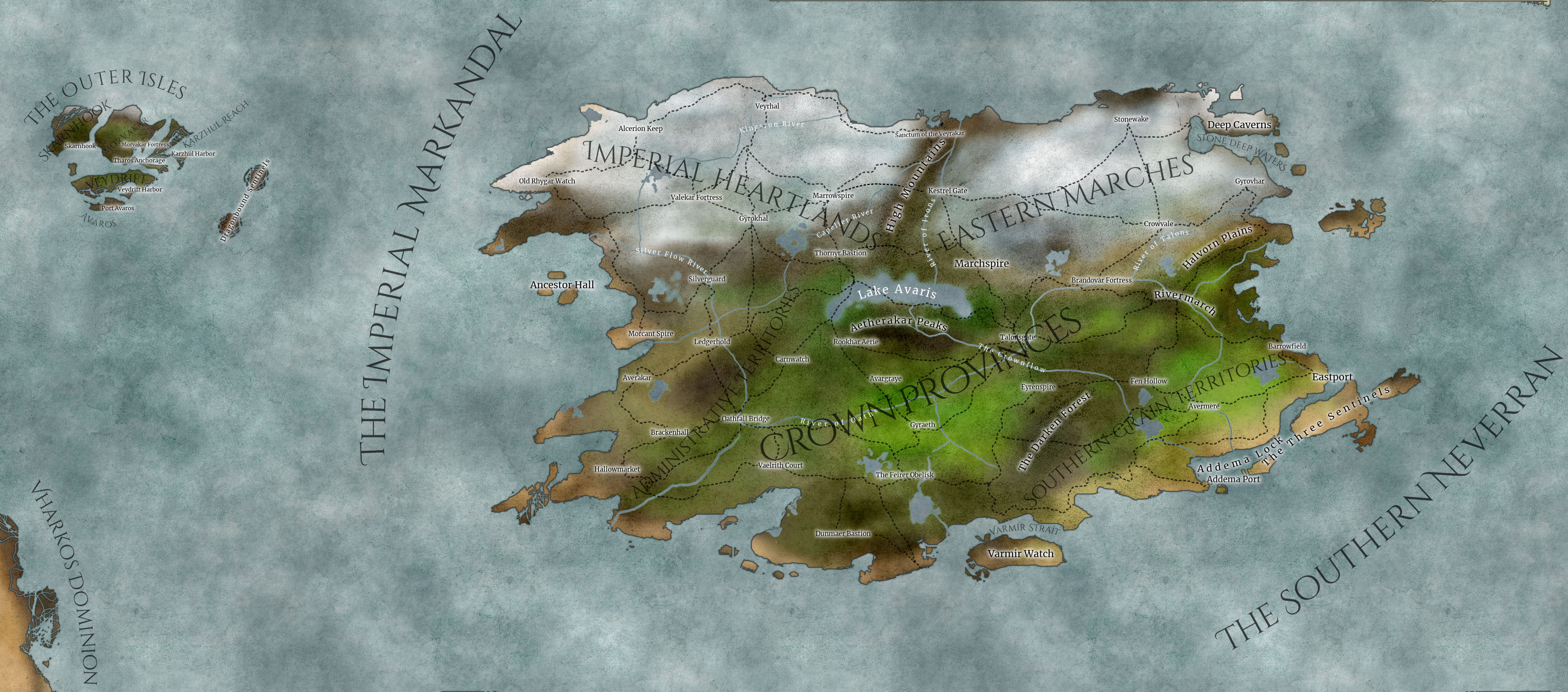
Houses of Averon & the isles
This is set during the time of the Five Kingdoms: Averon series. The houses for The Great Empire: Averon series will be here.
Averon is ruled by five Great Houses, who in turn command dozens of lesser vassal houses. House Beorthean, House Aerien, House Verasir, House Skant, and House Tagel are the five Great Houses that emerged after the Sundering of Crowns, which ended the Old Kingdom over a thousand years before the series begins. Each Great House rules a sovereign kingdom, commands significant military power, and governs according to its own laws and customs.Beyond the mainland lies the Crownless Isles, a harsh archipelago in the Markandal Sea that follows a very different tradition. Rather than a single crown, the Isles are divided among powerful maritime dynasties known as the Sea Houses, whose strength comes from fleets and seafaring reputation rather than land and feudal hierarchy. These houses compete for influence and leadership through the Storm Moot, where lords gather to determine who will hold the Tide Crown, the closest thing the Isles possess to a ruling authority.Long before the Old Kingdom, however, the continent was once dominated by the ancient Empire of Gyrok, whose throne was held by the dragon-ruling Great House Helyrion. Known as the Dragon Sovereigns, House Helyrion was believed to possess traces of dragon blood, allowing its rulers to command the loyalty of living dragons and maintain power through the legendary Dragon Throne.A list of the Great Houses of Averon and the dominant Sea Houses of the Crownless Isles, along with some of their more significant vassals, follows:
Kingdoms of Averon
The five kingdoms of the realm
High Lands Kingdom
The High Lands Kingdom forms the geographic and political heart of Averon, rising into rolling highlands threaded with ancient roads and symbolic power.
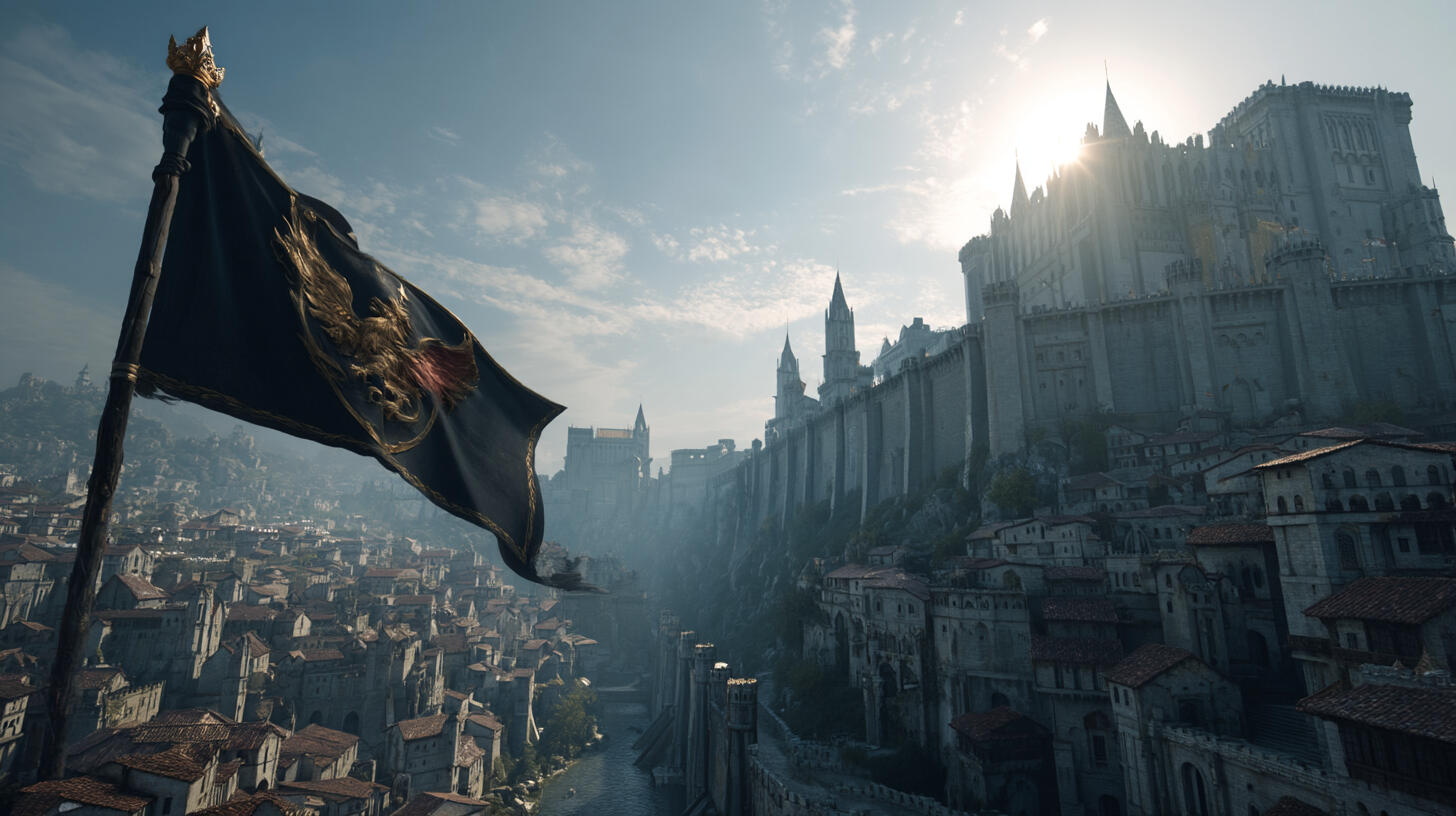
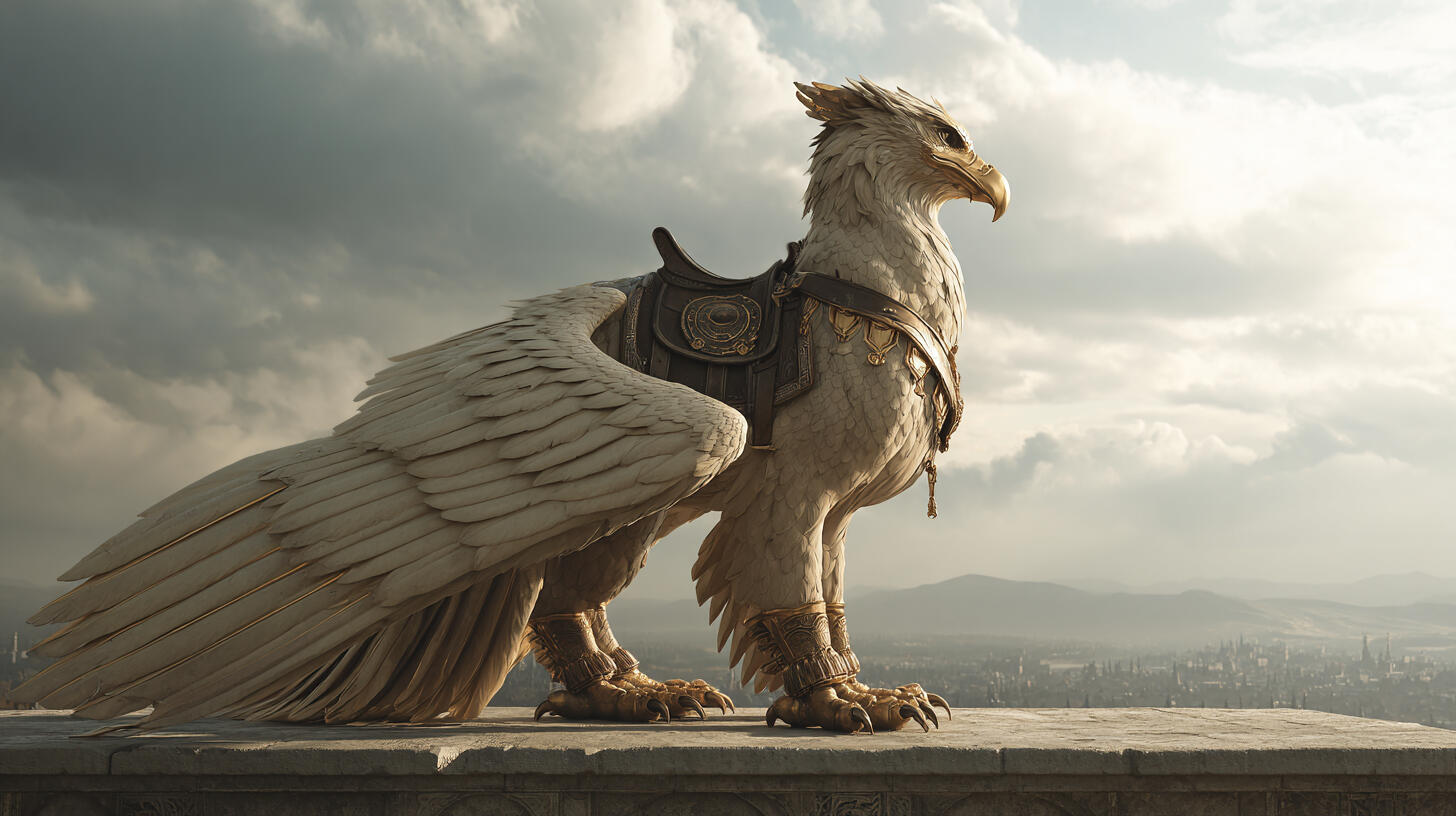
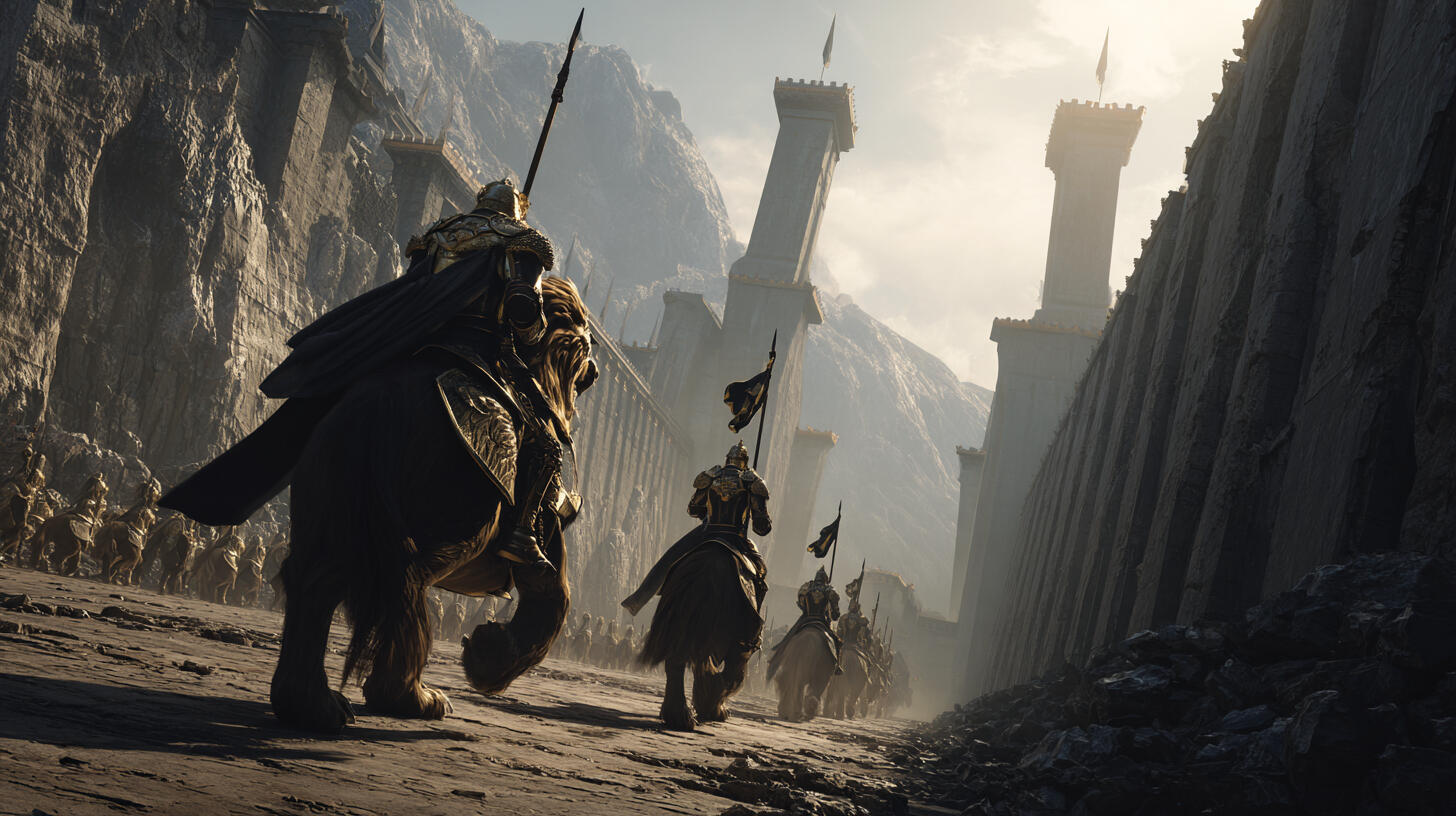
House Aerien rules through elevation, fear, and ancient authority, claiming legitimacy not only through blood but through visible dominance and ritualized power reinforced by the Ascendant Creed.
The High Lands Kingdom forms the geographic, political, and ideological heart of Averon, rising into rolling uplands threaded with ancient roads, fortified passes, and symbols of authority that long predate the Sundering of Crowns. Ruled from the capital of Highfall, the kingdom derives its power not from abundance or conquest, but from legitimacy, tradition, and control of continental governance. The Crownflow River cuts through the region, sustaining settlements and serving as a ceremonial artery tied to rulership rites, while cities like Greyhaven function as critical crossroads linking westward trade, northern military routes, and eastern border roads. The High Lands are heavily fortified, bordered by The Wall and Thornwatch to the north, with Widow’s Peaks and Castle Rookwell guarding key approaches.The realm’s southern edge opens onto the High Crown Coast, where Dunmere Bastion and Harcliff Spire defend against naval threat along the Varmir Strait, while the Darken Forest forms a natural southeastern barrier separating the kingdom from Fieldmarch. Authority here is absolute and visible, enforced through law, ritual, and the ever-present Crownsguard, and shaped by House Aerien, whose rule emphasizes order, fear-backed stability, and public legitimacy over mercy or populism.
The High Lands Kingdom developed from one of the most elevated, strategically central, and symbolically charged regions in Averon. Before its consolidation as a sovereign realm, the territory consisted of upland roads, fortified heights, ridge settlements, and interior strongholds whose importance derived from elevation, defensibility, and control of overland movement rather than sheer agricultural abundance. During the age of Gyrok, the region already held major imperial value as a commanding inland corridor from which roads, messengers, troop movements, and continental traffic could be monitored between the western coast, the northern interior, and the southeastern routes. Its heights offered surveillance, defense, and secure interior staging, making it one of the empire’s most useful administrative and military upland zones.Later, under the Old Kingdom, that importance only deepened, as the region functioned as a strategic interior heartland valued for its commanding terrain, disciplined noble structures, and ability to link major parts of the continent through defended roads and fortified junctions.Following the collapse of the old continental order, the region fragmented into a contested upland power zone dominated by fortress lords, hereditary lines, and rival strongholds competing for control of roads, passes, and interior legitimacy. During the Sundering of Crowns, the High Lands became one of the most politically and symbolically significant theaters in Averon, as competing powers sought not only territorial control but the authority to define lawful rule in one of the old realm’s most central regions. From this environment, House Aerien emerged as the dominant ruling line through military superiority, political consolidation, and its growing association with griffin authority.
According to High Lands tradition, House Aerien became bound to griffins during the long centuries after the fall of older continental orders, when the Highlands were still divided among rival upland lords, fortress lines, and warring strongholds. Aerien ancestors are said to have discovered griffin nesting grounds in the harsh elevated reaches later tied to their power and, unlike every rival who sought those same heights, succeeded in surviving, holding, and eventually mastering what they found there.Whether through patience, brutality, instinct, or a quality later sanctified by the Ascendant Creed, the early Aeriens turned proximity into command. What began as a terrifying military and symbolic advantage became the foundation of their claim to rule, making House Aerien seem not merely stronger than its rivals, but divinely fitted to stand above them.
Griffins are not native to the continent of Averon and are widely believed to have originated in some distant land beyond any surviving map. For centuries they appeared only in scattered sightings across remote cliffs, high crags, and isolated nesting grounds, becoming known less as beasts of nature than as terrifying omens of elevation, judgment, and dominion. Their rarity, violence, and near-impossible mastery made them legendary across the continent, and over time they came to be regarded as the most powerful living creatures known to the world.By the age of the Old Kingdom, griffins had already passed into myth for much of Averon, though in the High Lands they remained more real, more feared, and more politically significant than anywhere else.
Northern Reaches Kingdom
The Northern Reaches Kingdom occupies the far northwestern edge of Averon, bordered by the Markandal Sea to the west and north and defined by cold coasts, old stone, and lingering imperial memory.
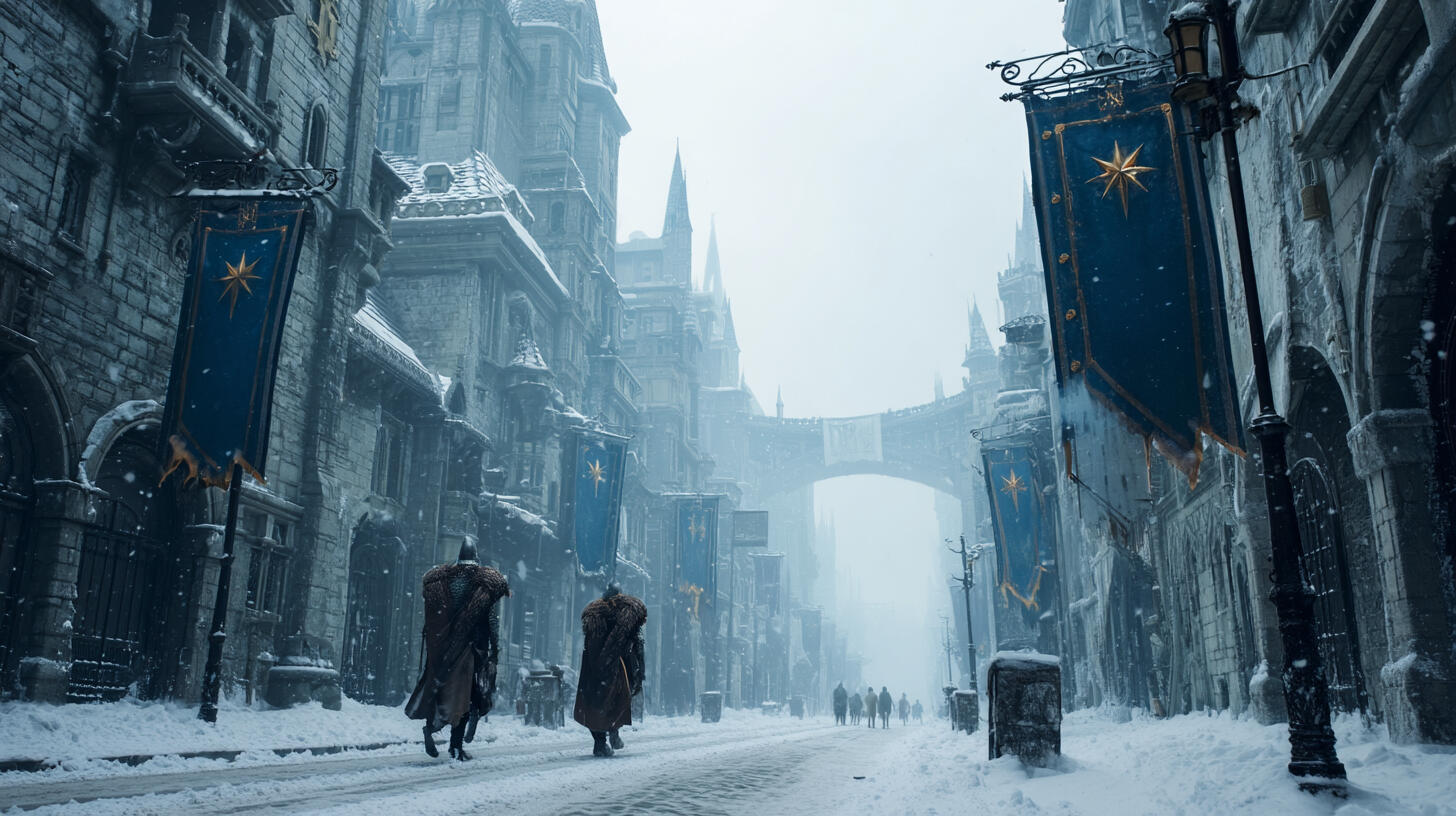
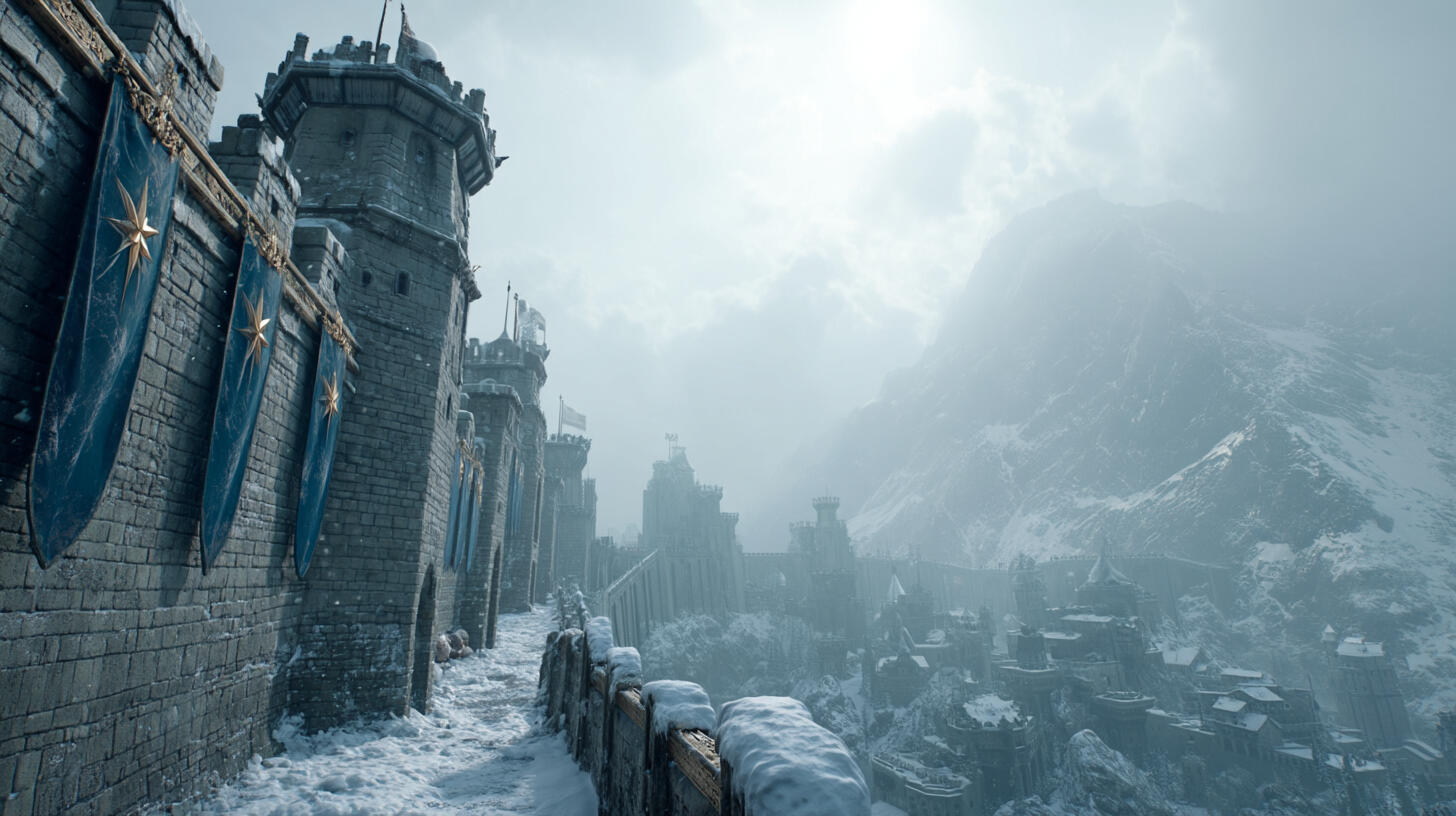
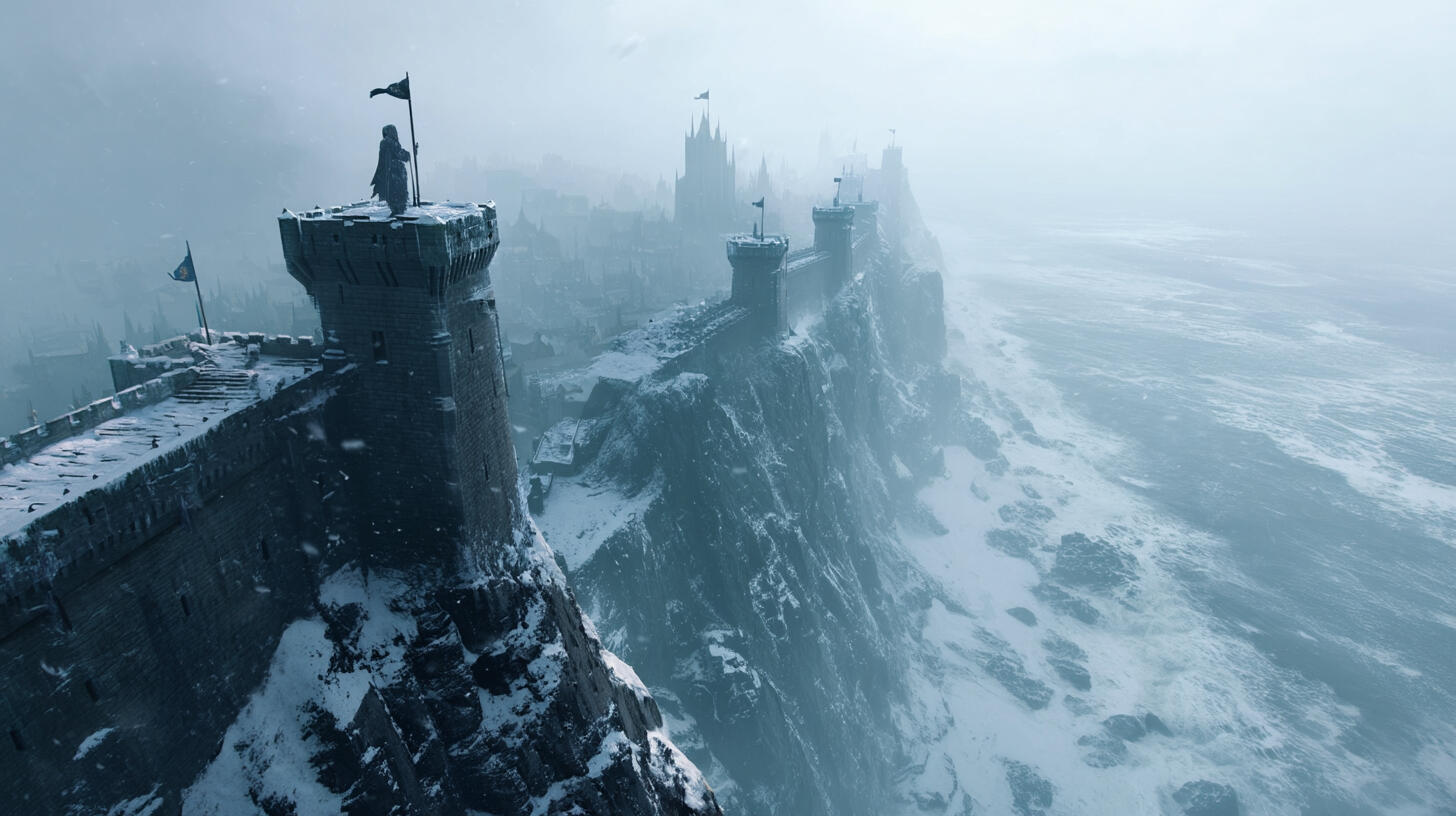
Once the royal bloodline of the Old Kingdom, House Beorthean governs by honor, restraint, and inherited duty, preserving older customs as proof that true rule is carried, not seized.
The Northern Reaches Kingdom occupies the far northwestern edge of Averon, shaped by cold seas, ancient stone, and lingering memory of the Old Kingdom’s ideals. Ruled from the inland capital of Kingsreach, deliberately set south of the exposed coast, the realm balances maritime vigilance with inward-looking tradition. The northern shoreline is crowned by Kingsfall, an ancient imperial seat overlooking the Markandal Sea, while the western coast is guarded by Alcrest Castle and Old Rhygan’s Tower, standing watch over the treacherous Sharp Rocks.Offshore to the southwest lies Ancestor Hall, a solemn island tied to lineage, burial, and oath remembrance. Inland, the Silver Flow River runs south past Silverkeep, carrying both trade and authority into the Western Bank, while the eastern interior rises sharply into the High Mountains, forming a natural barrier against North Rock. Noble power is anchored by fortified halls such as Valegray Castle in the northwest and Marrowyn Hall near the mountain foothills in the southeast, reinforcing old alliances and guarded roads. At the southern edge of the kingdom, Thornwatch stands fifteen miles from the The Wall, marking the hard border with the High Lands and serving as both fortress and ideological boundary.The Northern Reaches value honor, oaths, and restraint above ambition, holding fast to customs that predate the Sundering and judging rulers not by expansion, but by dignity, memory, and endurance.
The Northern Reaches were once the political heart of the greatest powers ever to rule Averon. In the age of the Empire of Gyrok, the region around what would later become Kingsreach is believed to have held the imperial capital itself. Long after Gyrok’s fall, the Old Kingdom built its own capital over that same ancient center, placing the High Throne there and making the north the seat of a unified continent. Because of this, the Northern Reaches became more than a region — they became the keeper of royal memory, legitimacy, and the physical remains of lost sovereignty.When the Sundering of Crowns shattered the old order, no kingdom lost more in dignity than the north. Though House Beorthean kept control of the region and endured as its ruling line, they lost the uncontested crown of all Averon. From that point on, the Northern Reaches Kingdom became defined not by victory, but by survival — a cold, severe realm shaped by memory, restraint, ancient duty, and the belief that the old order was never truly meant to die. Until the Red Massacre.
North Rock Kingdom
North Rock Kingdom stretches across the northeastern highlands of Averon, a region shaped by stone, war, and constant readiness.
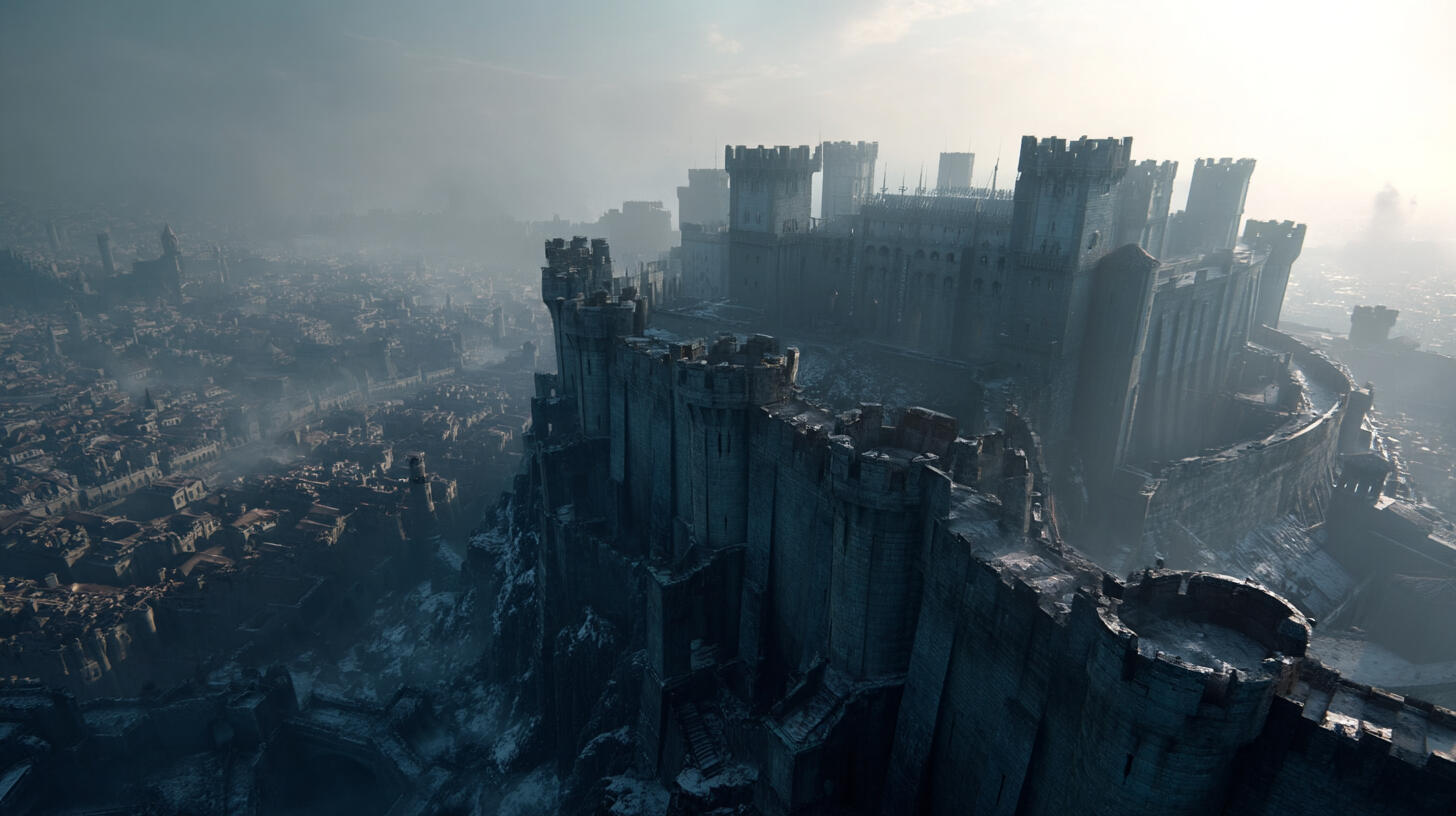
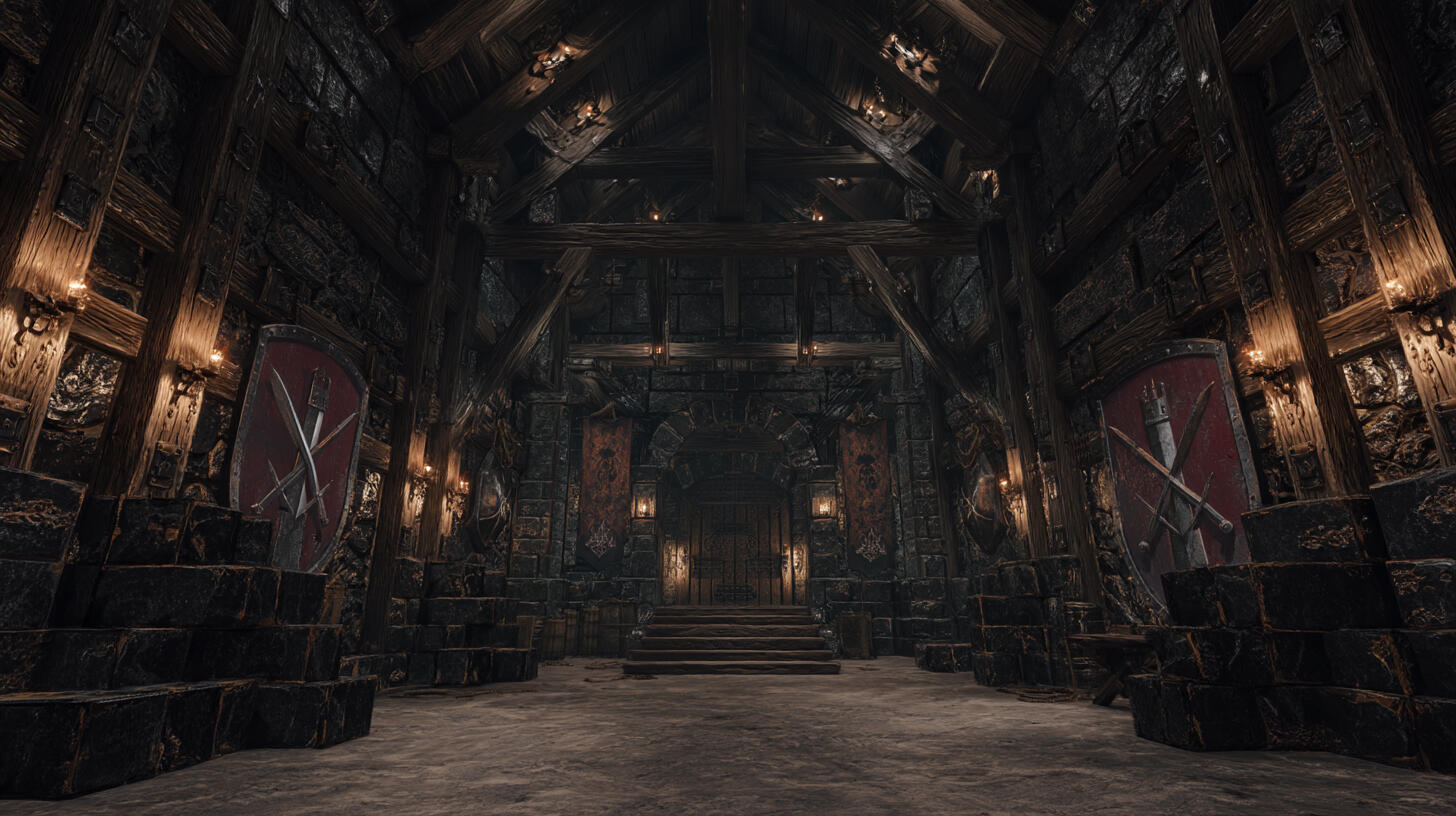
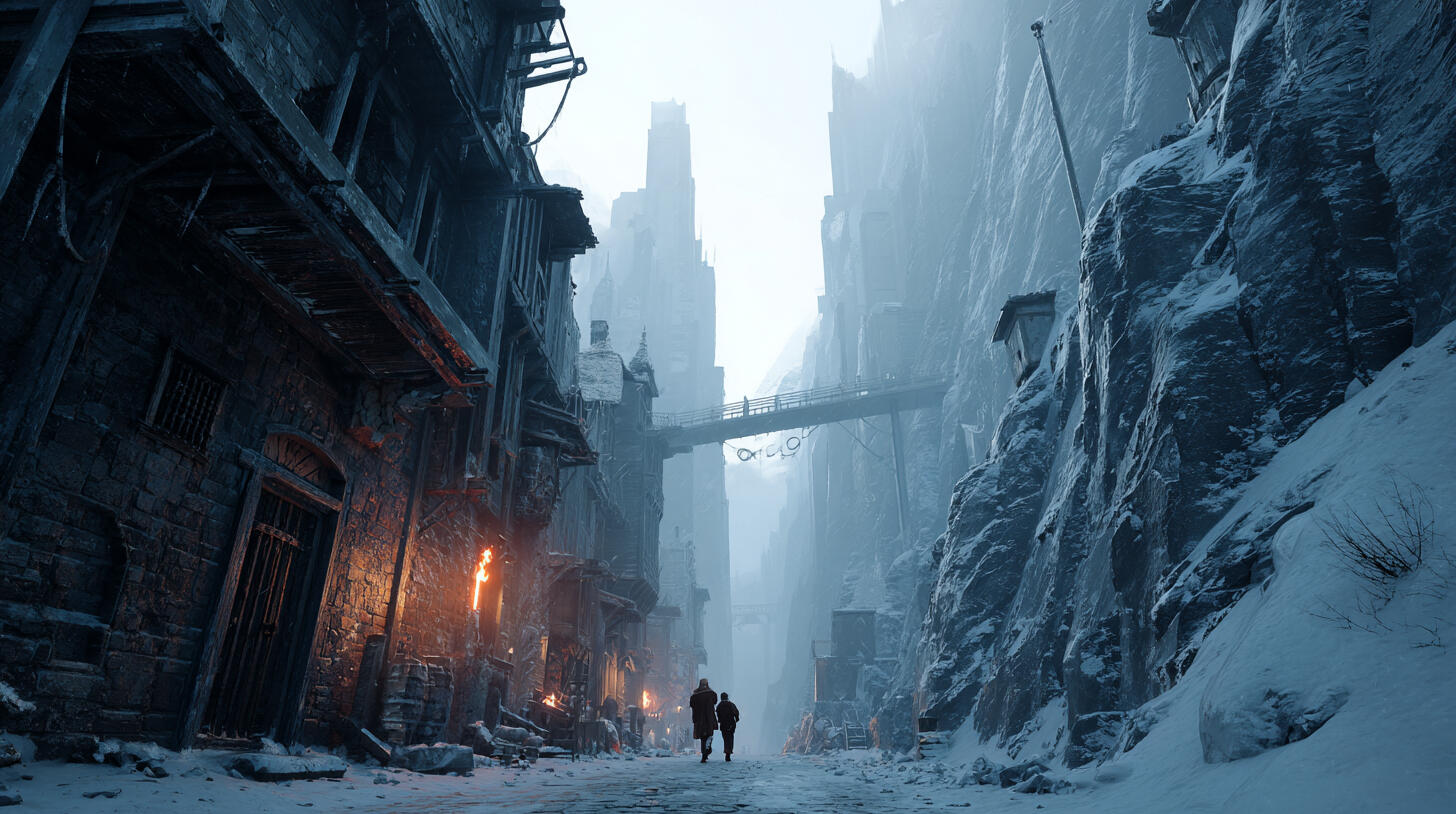
A conquest-born house, House Verasir believes authority belongs to those who can hold land by force, valuing strength, discipline, and unyielding military command above all else.
North Rock Kingdom spans the harsh northeastern highlands of Averon, a land defined by stone, elevation, and perpetual readiness for war. Entered primarily through the High Mountain passes near Kestrel Keep, the realm is structured around defense, mobility, and command rather than comfort or ceremony. Its capital, Ironwatch, stands east of the main passes where fortresses, garrisons, and military roads converge, functioning less as a courtly seat and more as a strategic command center. South of the mountains lies Marchspire, anchoring the western approaches, while routes eastward are guarded by Brandfort Castle, beyond which the land opens into Crowhurst Vale and the broad Halvorn Fields, regions prized for cavalry training and mass levies.To the north, the land slopes toward the sea, where Stonewake serves as the kingdom’s primary port, facing the dangerous Stone Deep Waters, with the Deep Caverns lying offshore and largely unexplored. The Ironvein River runs south along the western edge of the realm, while the Talonstride River cuts southeast through Rivermarch, linking North Rock directly to Fieldmarch’s grain routes.North Rock governance is unapologetically martial, valuing strength, command, and proven capability above blood alone, and its rulers are judged not by lineage but by their ability to hold ground, command loyalty, and respond decisively to threat.
The North Rock Kingdom developed from one of the most militarized and geographically severe regions in Averon. Before its consolidation as a sovereign realm, the territory consisted of mountain passes, fortified ridges, exposed roads, and contested marcher holdings whose primary value lay in defense, overland control, and strategic depth rather than agricultural or ceremonial importance. During the age of Gyrok and later under the Old Kingdom, the region functioned largely as a hardened borderland, where authority depended on control of keeps, roads, and armed strongpoints rather than stable civil integration.Following the collapse of the old continental order, the region fragmented further into a contested military zone dominated by marcher lords, fortress houses, and border captains. During the Sundering of Crowns, North Rock became one of the principal northern theaters of conflict, culminating in the rise of House Verasir through sustained warfare, territorial seizure, and disciplined military command. From that period onward, the kingdom’s political identity became closely tied to martial legitimacy. Unlike realms grounded primarily in inherited sanctity, religious authority, or institutional memory, the North Rock Kingdom has historically defined rulership through force, border security, and demonstrated command. It remains, in the present day, a heavily fortified and openly martial kingdom whose ruling culture holds that a sovereign unable to defend the frontier has no lasting right to the crown.
The War of the Stone Marches was the principal regional conflict through which House Verasir secured control over what later became the North Rock Kingdom during the Sundering of Crowns. Fought from approximately 14 BSC to 9 ASC, the war unfolded across the mountain passes, fortified ridges, and marcher strongholds of the northern interior, and was shaped less by a single undisputed hereditary claim than by military control of the marches themselves. At the time, the region was divided among rival fortress lords, border captains, and competing noble houses, each attempting to seize the collapse of the Old Kingdom for its own advantage. Over the course of the conflict, House Verasir distinguished itself through sustained siege warfare, disciplined field command, and the systematic seizure and retention of strategic keeps, roads, and passes. By the war’s end in 9 ASC, Verasir had eliminated or subordinated its major rivals and emerged as the dominant military power in the region, establishing the foundations of the later North Rock monarchy.
Western Bank Kingdom
The Western Bank Kingdom runs along Averon’s western coast, shaped by rivers, records, and relentless administration.
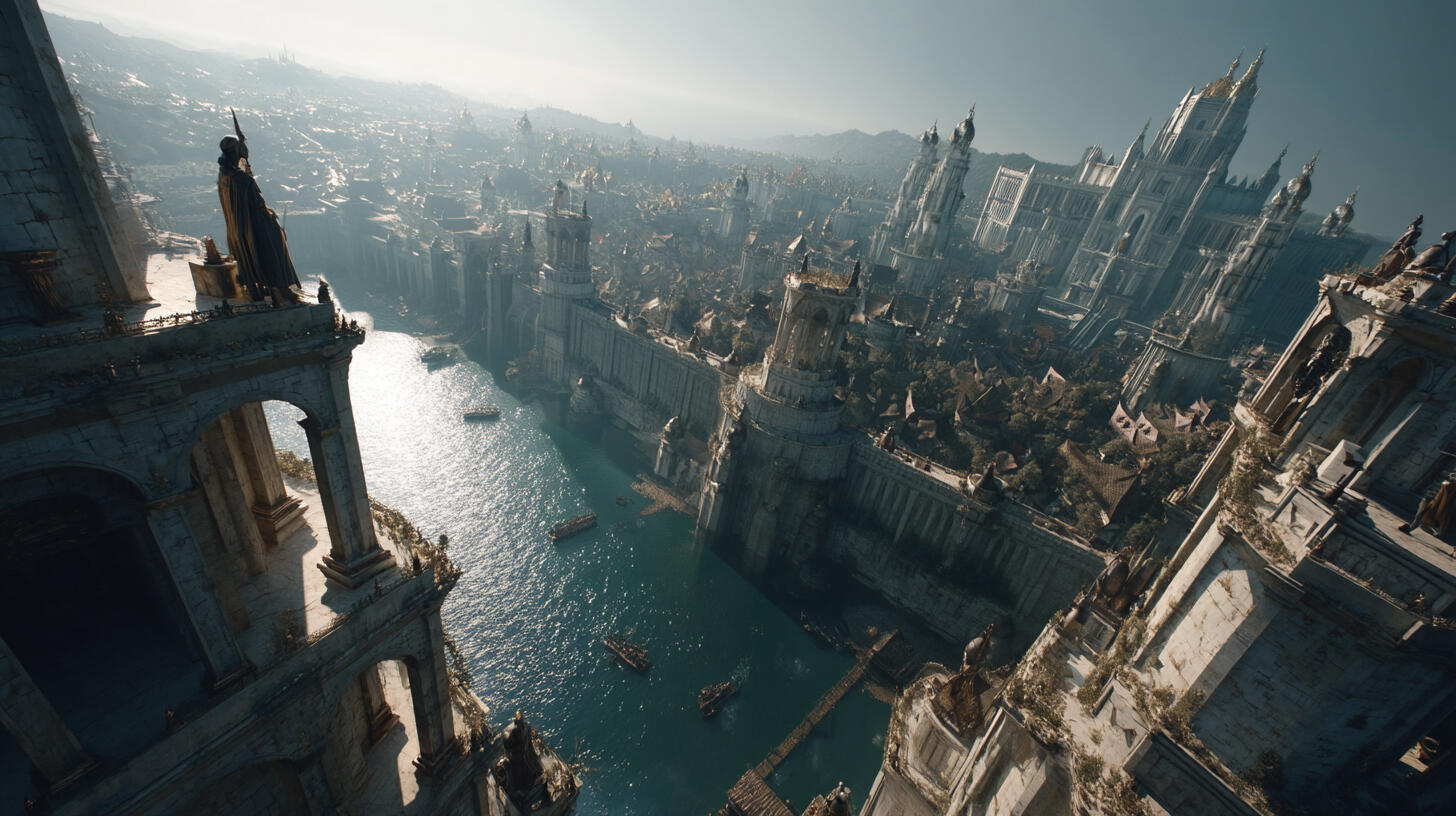
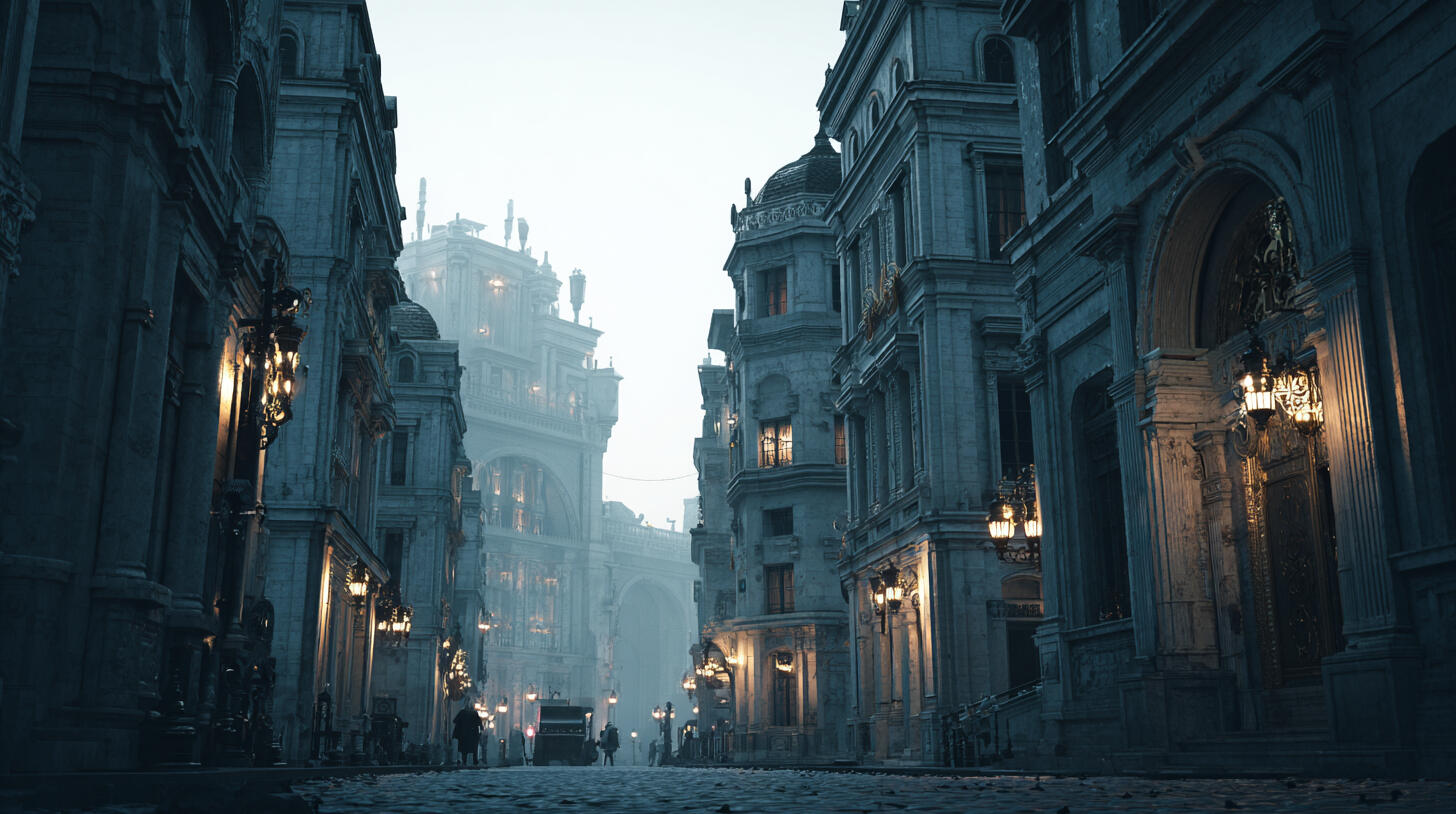
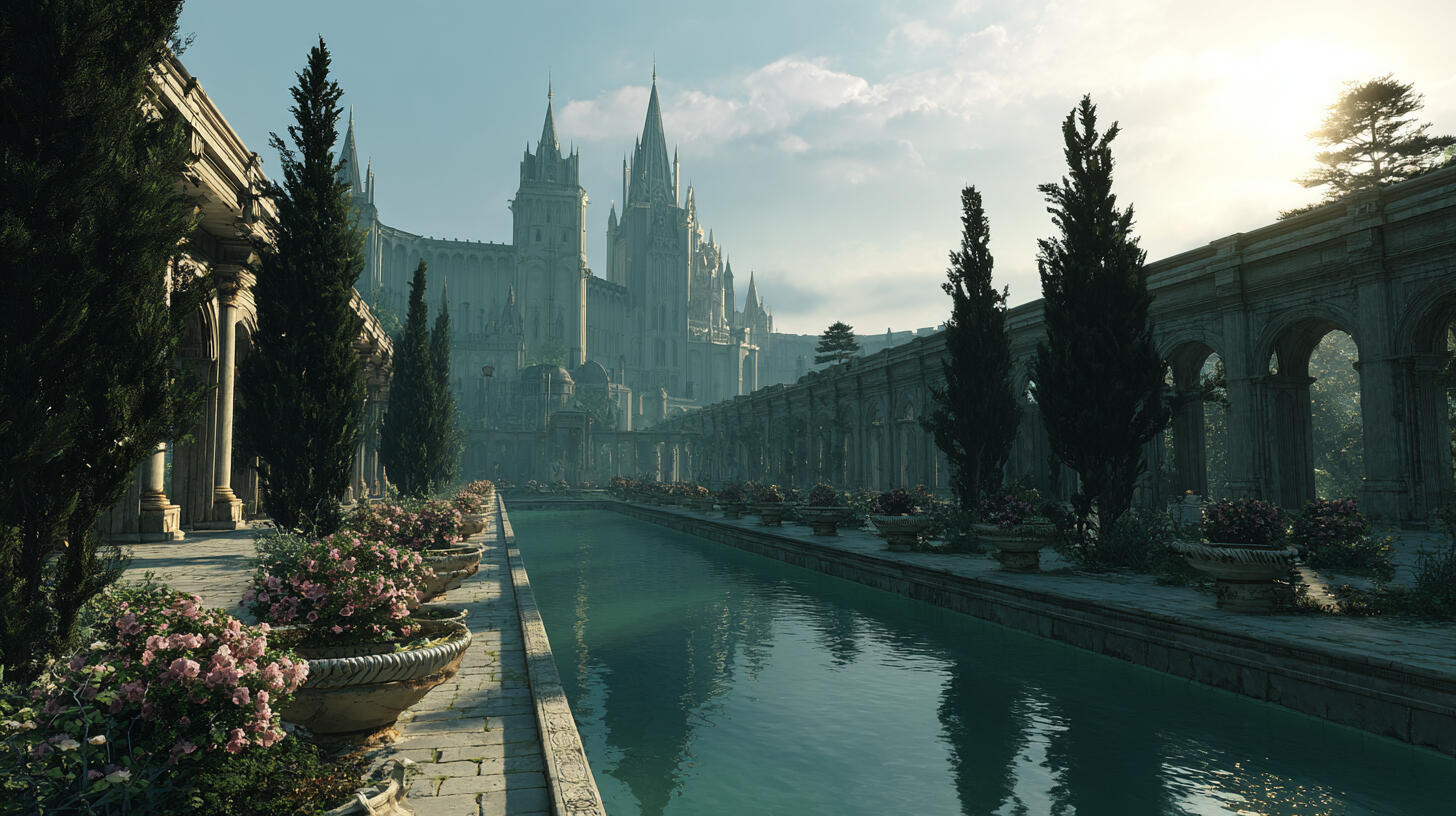
House Skant rules through law, precedent, and record, mastering succession and governance by turning written legitimacy into their sharpest weapon.
The Western Bank Kingdom stretches along Averon’s western coastline, a realm shaped not by armies or ancient bloodlines, but by records, rivers, and unyielding legal authority. Its power flows southward with the Silver Flow River, which enters the region from the Northern Reaches through Silverkeep, widens near Ledgerfall, and empties toward the coast near Charter’s Keep along the Markandal Sea. The capital, Charterfall, sits just inland from the coast, deliberately placed to balance maritime trade access with administrative security, and serves as the legal and bureaucratic heart of the kingdom. Inland routes from Ledgerfall pass Carnwatch and lead toward Brackenholt Hall, where lesser houses enforce precedent and procedure rather than force of arms.Along the eastern border, travelers cross the River of Oaths at Broken Oaths Bridge, marking the boundary where Western Bank governance gives way to the High Lands’ authority. The southern coastline hosts Hallowmarket, a pressure outlet for trade and dispute, while the Black Archive occupies a secluded northern shore, safeguarding sealed records and contested claims.At the far southwestern edge of the realm stands the Pale Monastery, isolated on its own island above the sea, where the Concord maintains the official records, treaties, and lineages of all Averon.Western Bank rule is defined by documentation, precedent, and delay, where power is exercised through ink and seal rather than steel, and a claim unrecorded is treated as a claim that never existed.
The Western Bank Kingdom developed from the river-coast corridor in which trade, law, and recorded legitimacy became closely linked. Prior to its consolidation as a sovereign realm, the region was defined by toll roads, charter towns, river crossings, clerical houses, and inspection points along the Silver Flow and the western coast. Settlements such as Ledgerfall, Carnwatch, Brackenholt Hall, and later Charterfall grew in importance through administration, taxation, and recordkeeping rather than battlefield prominence. During the age of Gyrok and later under the Old Kingdom, Western Bank functioned primarily as a managed corridor of passage, customs enforcement, and legal recognition, where scribes, magistrates, and customs officers held unusual political weight. It was within this environment that institutions such as the Concord emerged and endured, establishing traditions of verified record, witnessed inheritance, and binding charter before the region existed as a kingdom in its own right.Following the collapse of the old continental order, the region entered a prolonged period of procedural conflict supported by selective force, intimidation, and political removal. During the Sundering of Crowns, rival houses, merchant interests, magistrates, and legal factions competed through inheritance disputes, confiscated rights, altered testimony, sealed precedents, erased claims, intercepted charters, and the controlled disappearance of obstacles.The Concord remained the highest recognized authority in matters of lawful legitimacy, while the Black Ledger was widely rumored to preserve information that official record could be altered to exclude. From this environment, House Skant emerged as the ruling power of the region, though the legitimacy of its ascent has long remained subject to suspicion. Official histories present the Skant claim as lawfully secured through precedent, recognition, and succession confirmation, but enduring traditions maintain that the house rose through calculated betrayal, the discrediting of stronger bloodlines, and the timely elimination of rival claimants whose rights became impossible to prove.Regardless of the truth of those claims, House Skant secured control of the institutions that determined what was lawful, inheritable, and enforceable, and thereby established the crown of Western Bank.
Field March Kingdom
Fieldmarch Kingdom spreads across the fertile southeastern plains of Averon, defined by rivers, ports, and vast agricultural lowlands.
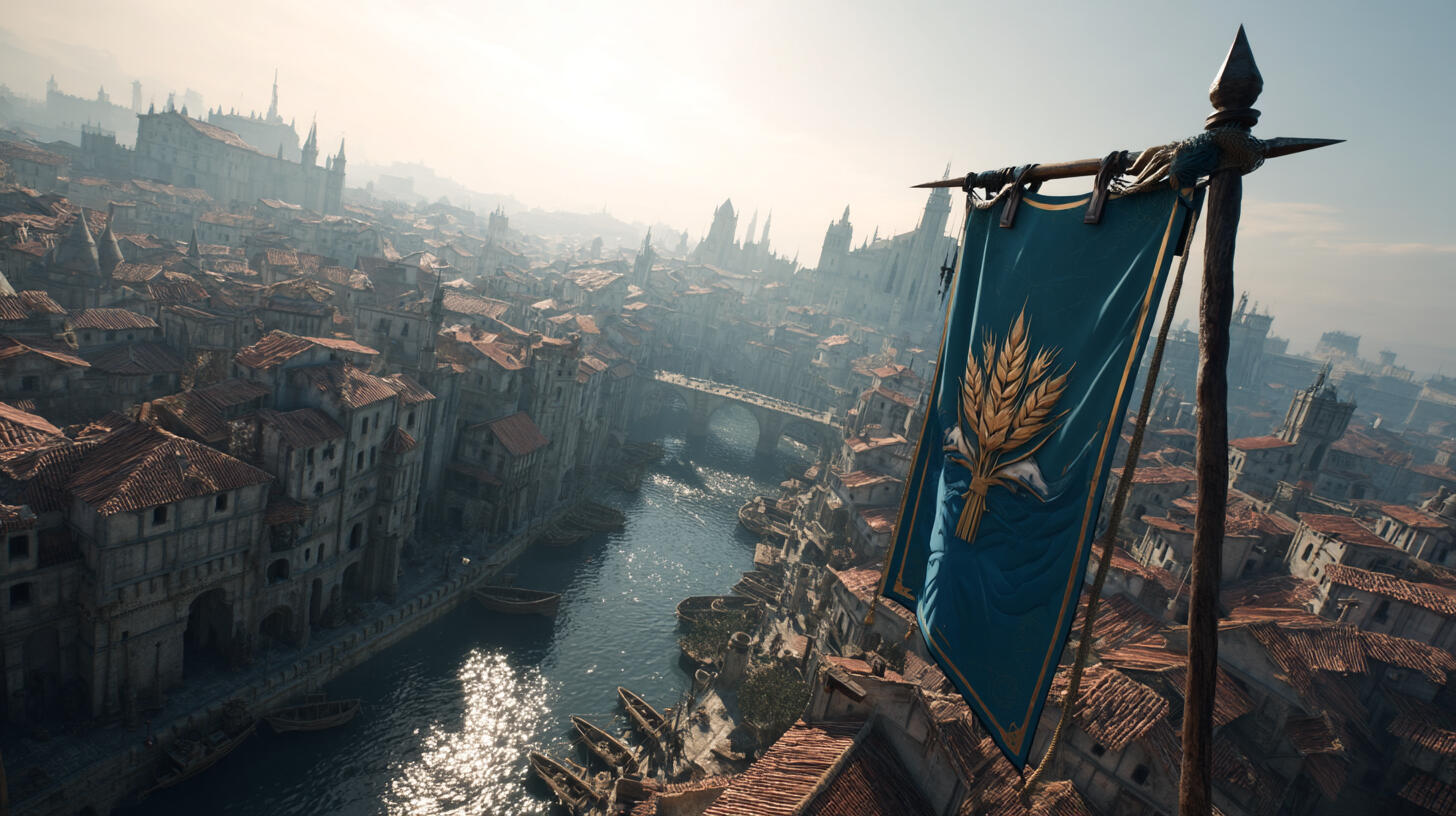
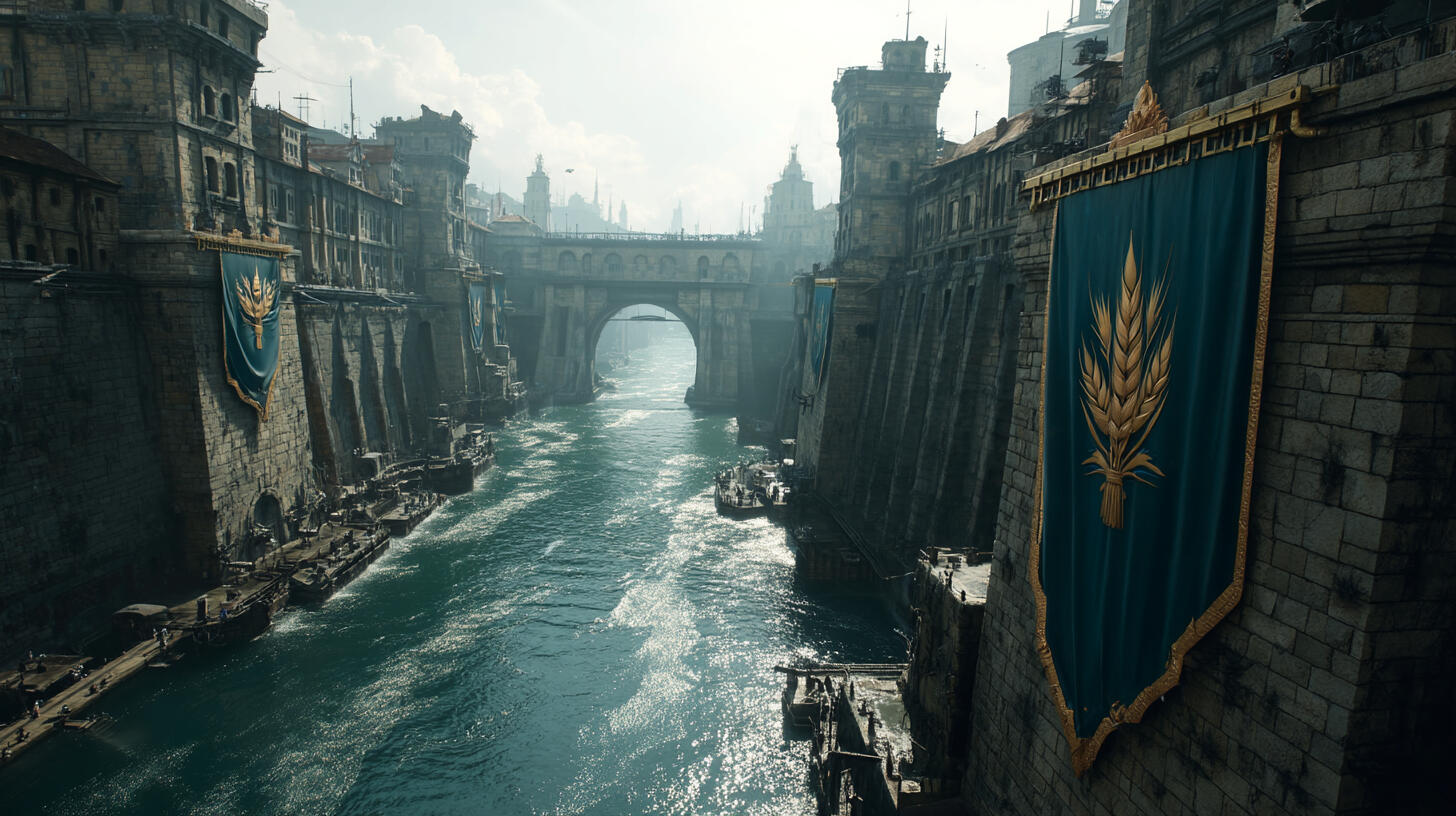
House Tagel commands Averon through grain, rivers, and survival itself, wielding food and supply as quiet power more decisive than crowns or armies.
The Fieldmarch Kingdom spreads across the fertile southeastern plains of Averon, a land defined by grain, rivers, and the quiet power of sustenance rather than armies or law. Entering from the High Lands, travelers pass through the southern edge of the Darken Forest before emerging near Fenick Hollow, where marshland slowly gives way to managed farmland and drainage canals. The Crownflow River enters Fieldmarch from the northwest below the High Lands, bending south toward Addema Lock, where its waters are divided, regulated, and measured to sustain irrigation, river traffic, and famine reserves.North of the Crownflow, Barrowfield Manor dominates the largest continuous grain plains in Averon, while Old Copley Court lies southwest of the capital, anchoring some of the region’s oldest and most conservative farmland. The capital, Wheaten, stands inland on stable ground, deliberately removed from flood risk yet bound to every corner of the kingdom by roads and river tallies, connecting north to Rivermarch along the Talonstride River, east to Eastport on the Gulf of Tagel, and south to Addema Port, where river cargo meets open sea trade.Offshore, the Three Old Towers rise from separate islands southeast of Addema Port, while far to the southwest Varmir Watch commands the narrow Varmir Strait, controlling passage between the Gulf of Tagel and the Neverran Sea.Fieldmarch rule rests on preparation rather than conquest, where authority is judged by whether the realm survives winter fed, supplied, and stable.
The Fieldmarch Kingdom developed from the most agriculturally productive lowland region in Averon, but its wealth was never gentle in origin. Before its consolidation as a sovereign realm, the territory consisted of fertile plains, marsh-fringed farmlands, river corridors, and granary estates whose value lay in grain production, storage, and transport on a scale large enough to feed stronger and more glamorous powers. During the age of Gyrok and later under the Old Kingdom, the region functioned not as a celebrated political heartland, but as a heavily worked provisioning zone, where labor was harsh, hierarchy was rigid, and the demands of empire fell hardest on those closest to the soil. Grain quotas, transport levies, land seizures, and seasonal enforcement made the region indispensable but rarely honored. In older records, the wealth of the lowlands was built through extraction as much as stewardship, and the order imposed there could be brutal, especially in years of poor yield or wartime demand.Beneath later images of abundance, Fieldmarch retained a long memory of overwork, coercive harvest systems, and the savage truth that whoever controls food decides who lives through winter. Following the collapse of the old continental order, Fieldmarch did not break into open heroic warfare so much as descend into a quieter and more dangerous struggle over survival, supply, and succession.During the Sundering of Crowns, the region became one of the most politically lethal theaters in Averon, as competing grain houses, river lords, landed stewards, and provisioning authorities fought through sabotage, arranged deaths, inheritance ruptures, intercepted shipments, famine pressure, and strategic marriage rather than open conquest alone. Armies still marched, but many of the most decisive victories in Fieldmarch happened in ledgers, storehouses, winter contracts, and poisoned households.From this environment, House Tagel emerged not because it was the most glorious claimant, but because it proved the most stable, ruthless, and indispensable. By securing the granaries, river access, and internal food networks while rival lines collapsed through political murder, internal betrayal, and resource failure, House Tagel established itself as the ruling power of the region. From that period onward, the Fieldmarch Kingdom became defined by agricultural legitimacy, financial discipline, and the political authority that comes from controlling sustenance.
The marshlands and drowned edges of Fieldmarch have long been associated with stories of witches, reed spirits, and swamp creatures older than the kingdom itself. Smallfolk speak of marsh women living beyond the managed fields and river roads, feared as healers, poisoners, curse-workers, and keepers of forbidden knowledge tied to sickness, flood, and rot. Alongside them endure tales of bog-things, drowned wanderers, reed wraiths, and scaled beasts lurking beneath black water, especially in the wetter lowlands and marsh country surrounding Fenick Hollow.Though such stories are dismissed publicly by most nobles as peasant superstition, they remain deeply rooted in Fieldmarch memory, and even practical men are known to avoid certain waters after dark.
The Addema fleets are the river and port vessels controlled by House Addema, forming one of the most important logistical forces in Fieldmarch. Operating from Addema Port, they oversee barge traffic, grain movement, trade tolls, and the guarded shipment of harvest stores through the kingdom’s river systems and southern waters.In times of war, famine, or political unrest, their importance increases sharply, as whoever controls the Addema ships can influence not only trade, but survival across much of southern Averon.
Culture Archive
This includes info for the FGK:A and TGE:A serie(s).
Holidays & Public Events that are continent-wide across all of Averon
Oathmoot Week — an early-spring week when lords renew key oaths publicly, disputes are “paused,” and the Concord records fresh seals for the year.Sundering Night — a late-autumn vigil marking the fracture of the Old Kingdom; fires burn in silence, and saying the wrong name can start fights.Waymark Fair — rotating market-festival hosted near major crossings where the Charterhouse sells new passage writs and merchants gamble on next season’s routes.Northern Reaches Events:The Bearing Days — formal court season where petitions are heard in open halls; nobles attend because refusing to be seen is suspicious.Starwake — a winter ceremony under the crowned-star banner honoring old royal memory; it’s polite, cold, and full of subtle political tests.The White Mantle Tourney — a prestigious tourney where victory is less about brutality and more about composure, courtesy, and “clean honor.” Any are invited to join from any kingdom. Is held once a year in early spring. Happens near Silverkeep.North Rock Events:The Steel Oath Muster — an annual mustering where captains swear fresh oaths before weapons and witnesses; promotions and demotions happen openly under the ruler of North Rock.Border Hunt — a harsh late-summer campaign-season “hunt” that’s really patrol warfare (bandits, raiders, rival scouts) dressed up as tradition.The Ash-Drum Games — brutal competitive trials (archery, endurance, riding, shieldwork) used to rank companies before winter. Many noble houses across North rock take part during the spring every year. Happens in Marchspire.The Grand Tourney — A North Rock–only royal tourney held beneath Marchspire Castle in Marchspire every Autumn, restricted to Verasir vassals and sworn houses, where jousting and martial contests serve as a public measure of dominance, hierarchy, and internal rivalry rather than entertainment for foreign courts.Western Bank Events:The Ledger Opening — the public “start” of the fiscal year when toll schedules, tariffs, and legal calendars are posted to every kingdom; riots aren’t rare.Charter Court Season — a formal season of hearings where disputes are fought with precedent, witnesses, and procedural traps instead of blades.
The Ink & Silver Masque — elite festival in Ledgerfall where alliances are made behind smiles, and one signature can ruin a house.High Lands Events:The Acclamation Procession — a massive public procession reaffirming House Aerien rule in the capital of High Lands; attendance is “voluntary” the way a blade is “optional.”Ascent Day — a restricted holy-political day tied to Griffins; pilgrims are banned, and arrests are common “for safety.”The Black-Gold Lists — a martial showcase where the Crownsguard publicly names commendations and punishments to set an example.Fieldmarch Events:The Great Tally — harvest accounting season when granaries are measured, reserves assigned, and the Court of Grain effectively decides the year’s politics.Riverlock Festival — a river-port festival celebrating the river gods/goddesses they worship in Fieldmarch.The Winter Reckoning — a public evaluation of lords and stewards after winter in front of House Tagel.
Empire of Gyrok Events:Imperial Founding Day — a major imperial anniversary observed in Gyrokhal and provincial cities, where oaths are renewed to the Dragon Throne, Helyrion banners are displayed, feasts are held, and military processions remind the empire who rules.The Whitefire Vigil — a sacred Helyrion rite held inside the Whitefire Palace, where pale ceremonial flames said to descend from ancient dragonfire are tended by imperial priests while the imperial family receives renewed loyalty oaths from high nobles.The Great Muster — an imperial military inspection where levies, legion officers, banner houses, weapons, horses, armor, grain stores, griffin counts, and road readiness are counted; to commoners, it often means sons taken into service.The Tribute Counting — one of the most dreaded administrative events of the year, when scribes and tax officials measure grain, coin, livestock, ore, timber, ships, tools, and labor owed to Gyrokhal.The Road Opening — a post-thaw imperial inspection of roads, bridges, toll stations, and courier routes, when repairs are ordered, bandits are hunted, and provincial movement begins again under official watch.The Harvest Oath — a hated oath in the Southern Grain Territories and fertile provinces where local lords swear before imperial officials that Gyrok’s granaries will be filled before private stores are secured.Imperial Tourneys — major feast-season tournaments held throughout the Crown Provinces and Imperial Heartlands, where knights, legion champions, griffin riders, noble heirs, and provincial warriors compete for recognition, favor, appointments, and invitations to the Dragon Court.The Grand Tourney — the greatest imperial tournament of Gyrok, held only on rare and politically important occasions beneath direct Helyrion attention, where jousts, melees, mounted charges, archery trials, griffin displays, noble presentations, and courtly rivalries turn public spectacle into a battlefield of reputation, marriage, succession, and imperial favor.The Grand Feasts of the Dragon Court — vast elite feasts held during major ceremonies, victories, dynastic marriages, diplomatic gatherings, and the closing nights of the Grand Tourney, where music, food, wine, and luxury conceal insult, alliance-making, and quiet political warfare.The Dragon Procession — a rare imperial display involving dragon banners, relics, bones, scales, or living dragon appearances, meant to remind the people that House Helyrion rules by blood, flame, and ancient dominion.Public Punishments — executions and punishments for treason, banditry, tax fraud, rebellion, and false coinage staged in markets or before city gates as public reminders that imperial law is never distant.
Institutions of Averon
The Moot of Talonsgate:
A permanent diplomatic forum held at Talonsgate every two years where envoys, ransom-brokers, and border stewards negotiate truces, prisoner exchanges, trade protections, and road-rights under strict “steel-peace” rules that forbid armed dispute within the walls.The Waymark Charterhouse:
A neutral civic authority of engineers, roadwardens, and bridge-keepers who maintain Averon’s major crossings (especially Broken Oaths Bridge and key river fords) and sell “safe passage writs” recognized in all five kingdoms, making them indispensable to merchants and marching armies alike. Is normally held Brackenholt Hall every five years.
Ethnicities & regional identities of Averon & Beyond
Reachborn (Northern Reaches)Rockmen (North Rock)Highlanders (High Lands)Bankmen (Western Bank)Fieldmarchers (Fieldmarch)Crownfolk / Outer Islanders (The Crownless Isles/Outer Isles)Vharosi (Vharkos)
Gyrothian
The dominant imperial identity of the Empire of GyrokNorthborn
People of the cold northern heartlands surrounding GyrokhalMarchborn
People of the military marches, borderlands, fortified roads, and frontier provincesRiverfolk
People of the river provinces, ferries, mills, toll crossings, barges, fishing villages, and trade townsFieldborn
People of the rich agricultural provinces that feed the empireCoastborn
People of the coastal provinces, harbors, fishing towns, shipyards, salt houses, and sea roadsHighpass Folk
People of the mountains, cliff roads, high valleys, signal towers, and difficult passesOld Provincial Peoples
A broad term used by imperial scribes for conquered regional groups whose original names, customs, dialects, and clan identities predate Gyrok’s rule
Languages of Averon
Averic Common: The modern, living language of Averon, spoken across all five kingdoms in daily life, trade, warfare, and governance, with regional accents and slang but full mutual intelligibility; all commoners, soldiers, merchants, and most nobles speak Averic Common as their first language.High Averic (also called the Old Tongue): The ceremonial and historical language of the Old Kingdom, no longer spoken conversationally but preserved in royal inscriptions, ancient charters, coronation rites, sealed oaths, and Concord records, carrying immense symbolic authority where its use implies legitimacy, antiquity, and lawful continuity.Draconic (also called the Tongue of Flames): The ancient language spoken by dragons and the rulers of the Empire of Gyrok, believed to be older than High Averic. Draconic is a harsh, resonant language formed of deep consonants and elongated vowel sounds said to mimic the breathing patterns of dragons themselves. Surviving fragments appear in ancient runes, dragon-bound inscriptions, relics of House Helyrion, and the hidden records of the Veyrakar. Only a handful of individuals in Averon are believed capable of reading or speaking even fragments of Draconic in the present age.Old Provincial Tongues: Regional languages and dialects spoken by conquered peoples across Averon. Many survive in villages, remote noble courts, old songs, and private family rites.Proto-Averic: A developing common trade speech used by merchants, soldiers, servants, and travelers across imperial roads.
Commoner living in Five Kingdoms & Empire
Most commoners in Averon understand the world through weather, harvests, roads, and fear, not crowns or borders; few ever see a capital or meet a ruling lord, and most live and die within the same region. Power is measured locally, with garrison captains and tax collectors mattering far more than distant kings, and noble houses are known only when they bring soldiers, tolls, or famine.Justice is expected to be uneven, swift for the poor and negotiable for the powerful, and trials are widely believed to be performances rather than truth. Faith is practiced quietly and privately, especially where the Old Faith is condemned, with shrines hidden in homes, fields, or riverbanks.War is feared rather than celebrated, as it brings conscription, scarcity, and unsafe roads, while long-distance travel is rare and dangerous enough that crossing multiple kingdoms is considered extraordinary.Griffins are spoken of in whispers or disbelief, magic is publicly dismissed but privately suspected, and most common folk believe that the world is older, harsher, and far less just than those in power admit. That is why many either fear or respect House Aerien for being able to control Griffins.Most people think dragons are myth or blasphemous fable.
Commoner life depends heavily on province, season, occupation, and distance from imperial power. Most commoners are farmers, herders, fishers, miners, servants, craftsmen, laborers, dockworkers, carters, charcoal burners, millers, or tenant families bound to noble land.The empire promises order, roads, market protection, legal weights, and defense from raiders, but those protections come with heavy obligations. Commoners owe taxes, labor days, harvest shares, road tolls, military levies, and emergency tribute when demanded by imperial officials or provincial lords.In villages, life is measured by weather, planting, harvest, births, deaths, marriages, taxes, and the arrival of imperial riders. Most commoners do not care about court politics unless court politics bring soldiers to their fields.Imperial census-taking is feared. Scribes count households, livestock, grain stores, sons of fighting age, marriageable daughters, trade goods, and taxable tools. A village that hides wealth risks punishment, but a village that reveals too much may be taxed into hunger.Common homes vary by region. Northern homes are built low and sturdy against snow and wind, often of stone, timber, packed earth, and thatch. River provinces favor timber halls and raised storehouses. Coastal settlements use salt-worn wood, rope, tar, and stone. Wealthier towns have tiled roofs, paved streets, guild halls, public wells, and imperial shrines.Most commoners view House Helyrion with awe, fear, and distance. The emperor is not imagined as a man so much as a force — the one whose seal appears on taxes, soldiers, laws, coins, punishments, and distant rumors of dragons.Common folk may gossip about noble scandals, dragon omens, harsh governors, missing sons, food prices, road dangers, and whether the next tax season will be survivable. To them, the empire is both shield and chain.
Common Foods across Averon
Barley Bread – Dense, dark loaves baked daily; eaten with everything from stews to cheese.
Pottage – A thick stew of grains, roots, and whatever meat or vegetables are available; the backbone of common diets.
Salted River Fish – Especially carp or silverfin, dried or packed in salt for travel and winter stores.
Roast Turnips & Onions – Cheap, filling, and often cooked in hearth ash or fat.
Hard Cheese – Sharp, aged wheels meant to last through travel and winter, common in every region.
Meat Pasties – Pastry sealed around minced meat and vegetables, popular with soldiers and travelers.Small Ale – Weak, cloudy ale drunk daily instead of water; safe even for children.
Dark Beer – Stronger, bitter brews favored in colder regions and garrisons.
Spiced Cider – Apple-based, lightly fermented, especially common near harvest seasons.
Mead – Honeyed and celebratory, often reserved for feasts, weddings, and festivals.
Herbal Infusions – Non-alcoholic brews made from roots and leaves, common where ale is scarce.
Taboo topics & insults across Averon
Across Averon, questioning the legitimacy of a ruling house, openly praising the Old Kingdom, or suggesting the Concord alters records are considered dangerous subjects, often provoking silence or swift punishment. Insults commonly target lineage, honor, faith, and competence rather than personal behavior, as identity and reputation are inseparable from survival.Northern Reaches
Calling someone “oath-thin,” “unbearing,” or accusing a house of forgetting its vows is a grave insult, while mocking the Old Kingdom or the Rite of Bearing is taboo.North Rock
Insults focus on weakness, such as “soft-handed,” “wall-hiding,” or “unblooded,” and questioning a leader’s military competence is deeply offensive.Western Bank
Calling someone “unrecorded,” “ledgerless,” or “procedurally false” is a serious slight, and openly criticizing the Concord or written law is taboo.High Lands
Suggesting a ruler lacks Aerien favor, griffin legitimacy, or public acclamation is treasonous speech, and calling someone “low-sighted” or “ground-bound” is insulting.Fieldmarch
Accusations of hoarding, waste, or mismanaged harvests are among the harshest insults, and speaking lightly of famine or price manipulation is socially forbidden.
Factions of Averon
The Crownsguard
The elite royal guard of the High Lands, sworn directly to House Aerien and trained primarily at Dunmere Bastion, serving as both protectors of the capital and a symbol of lingering continental authority.• They matter because their loyalty is watched closely by every kingdom, and rumors persist that parts of the Crownsguard still believe in a single ruler for Averon.
• Their uniform colors are black and gold. Often feared and respected across the High Lands.
The Concord
The Concord is a continent-spanning monastic order based primarily at the Pale Monastery in Western Bank, responsible for the preservation, verification, and interpretation of all official records in Averon, including births, deaths, marriages, oaths, land charters, and succession claims. Though outwardly neutral and ascetic, the Concord wields immense quiet power, as nothing is considered legally true unless it is sealed, copied, and recognized by their scribes, making them the ultimate arbiters of legitimacy across all five kingdoms.• The Concord claims independence from all noble houses, yet its records determine which houses rise, fall, or vanish from history entirely, and many believe its archives contain omissions and alterations dating back to the Sundering of Crowns itself.
• Passage to the Pale Monastery is hard to get to due to the rocky waves surrounding the island.
The Order of the Veiled Star
The Order of the Veiled Star is a clandestine ideological brotherhood devoted to preserving the memory and legitimacy of the Old Kingdom and the High Throne, believing that Averon was never meant to be divided and that the Sundering of Crowns was an unnatural fracture of rightful rule.Though officially dismissed as relic-keepers and harmless traditionalists, the Order operates quietly across all five kingdoms, embedded within courts, garrisons, monasteries, and noble households across all of Averon.
• They do not seek power openly; they seek continuity. House Aerien deems any who are a part of this order to be traitors to their kingdom and has them to be arrested on sight.
• It is rumored that House Beorthean has ties to this order.• In the first century of the Old Kingdom, the High Throne secretly tasked the Order of the Veiled Star with eliminating the last surviving dragons that still remained across Averon after the fall of the Empire of Gyrok and its dragon-ruling dynasty House Helyrion, whose legacy threatened the legitimacy of the newly rising crown. The Order became the primary force behind systematic dragon hunts across the continent, studying the creatures and developing weapons and tactics specifically meant to kill them.
• Within roughly one hundred years of the Old Kingdom’s founding, dragons had vanished completely from the known world, and the Order helped reinforce the belief that dragons had been nothing more than dangerous beasts or exaggerated myths, ensuring the connection between dragons and the lost empire of Gyrok faded from public memory.
• Unknown to them, however, the once proud Order turned secretive cult known as the Veyrakar had hidden several dragon eggs deep within their sanctum during the fall of Gyrok, allowing the last dragons in the world to survive far beyond the reach of the dragon hunters.
• The current Grandmaster of the Order is Lord Calstar Alcrest.
The Ironward
The elite royal guard of North Rock, sworn directly to House Verasir and stationed primarily within Ironwatch and the Marchspire forts, serving as both enforcers of Verasir rule and the final authority in matters of internal order.• They matter because their loyalty is absolute and unquestioned, feared even among North Rock nobility, and their presence signals that mercy is no longer an option.
• The Ironward are not diplomats or peacekeepers; they exist to end conflict swiftly and decisively before it spreads.
• Their uniform colors are blackened steel and deep red, often worn scarred rather than polished, and they are widely regarded as one of the most ruthless and disciplined royal forces in Averon.
The Fieldsguard
The sworn knightly order of Fieldmarch, bound to House Tagel and charged with protecting the fields, granaries, river routes, and supply chains that keep the realm fed, serving less as champions of war and more as enforcers of stability and order.• They matter because in Fieldmarch food is power, and whoever controls the harvest controls the kingdom; the Fieldsguard ensures that shortages, unrest, and defiance are ended quietly before they spread.
• Their uniform colors are blue and green with muted field-gold accents, favoring practical armor over ceremony, and they are widely regarded across Averon as dependable, unglamorous, and quietly feared.
The Winterbound
The elite royal guard of the Northern Reaches, sworn beneath Old Kingdom rites and bound directly to the Beorthean crown, serving as the personal protectors of the High Throne (even when it was believed to have long since fallen across Averon) and the final enforcers of ancient northern law within Kingsreach.• They matter because the Winterbound do not swear loyalty to a reigning monarch, but to the endurance of the crown itself; their oaths are believed to predate the Sundering of Crowns.
• Members of the Winterbound are oathbound for life and forbidden from holding lands, titles, or heirs while in service. To oppose a Winterbound is to defy tradition older than any living house.
• Their uniform colors are deep northern blue and muted gold; their armor is severe and unadorned, marked only by a restrained Beorthean sigil or winter-bound star.
The Court of Grain
The Court of Grain is a powerful economic council based entirely in Fieldmarch, operating from the fertile southeastern plains where the greatest grain reserves, granaries, and river locks of Averon are concentrated. Though it holds no crown and claims no kingdom beyond Fieldmarch, its decisions determine food distribution across all five realms, giving it quiet authority over survival, stability, and war.• Fieldmarch is its heart; the rest of Averon is its dependency.
• West Bank negotiates constantly to avoid embargo
• High Lands stockpiles heavily to reduce dependence
• North Rock guards supply routes as strategic assets
• Northern Reaches remembers famine during the Sundering and mistrusts the Court deeply
The Ashen Continuum (The Veyrakar)
It is a forbidden cult rumored about across some of Averon, feared for its rejection of all recorded history, lineage, and lawful rule. They are hunted in every kingdom, not for conquest, but for what they seek to unmake.• The Ashen Continuum believes the world once belonged to the ancient Empire of Gyrok, a civilization older than the Old Kingdom where the rulers of House Helyrion sat upon the Dragon Throne and governed beside living dragons. To them, dragons were never beasts of war but the true sovereign powers of the sky, while creatures such as griffins are seen as lesser imitations that later cultures elevated out of ignorance.
• They view the Old Kingdom and the later Five Kingdoms as fragile political structures built atop the ruins of a far greater order. In their doctrine, the Sundering of Crowns was not a rebirth of freedom but the final stage of Gyrok’s erasure, when the memory of the dragon empire was deliberately buried by the new rulers of Averon.
• The Continuum believes that the destruction of House Helyrion severed the ancient bond between dragons and mankind. Because of this, they see the noble houses, historical archives, and bloodline records of the Five Kingdoms as tools used to bury the truth of the dragon dynasty, making institutions such as the Concord and the established noble houses their natural enemies.
• Rather than seeking open conquest, the Ashen Continuum works through disruption and decay. They believe that weakening kingdoms through famine, fractured alliances, and collapsing legitimacy will eventually expose the lies written into Averon’s history and allow the forgotten truths of Gyrok to rise again.
• Among common folk, the Ashen Continuum is often dismissed as little more than a frightening rumor or cautionary tale told to children. In taverns and village hearths they are spoken of like the boogeymen of Averon—shadowy conspirators blamed for disasters, assassinations, and mysterious collapses of power, whether they were involved or not.
The Keepers of the Quiet Faith
The Keepers of the Quiet Faith follow the Old Faith, a belief system that predates the rise of the Old Kingdom and was practiced across Averon before crowns, borders, or dynasties divided the land. They hold that the world was once governed not by kings or conquest, but by balance, continuity, and restraint, and that the fracturing of Averon into realms was merely the latest expression of humanity’s failure to accept limits. They do not reject the Old Kingdom outright, but see it as a temporary order layered atop an older truth, one that existed before the High Throne and will endure after all crowns have fallen.• The Old Faith also spoke of dragons being the true beings of power, not griffins. And that is considered heresy to most believers of the Ascendant Creed.The following Great Houses formally condemn the Old Faith:
• House Aerien denounces the Old Faith as a threat to divine and dynastic authority, arguing that a realm without sanctioned belief cannot be ruled, and quietly authorizes suppression where Quiet Faith influence undermines loyalty to the High Lands.
• House Skant labels the Old Faith subversive, claiming its rejection of written law and sanctioned legitimacy erodes the foundations of governance, and has used Concord-recognized decrees to outlaw its rites in West Bank cities.
• House Verasir considers the Old Faith dangerous weakness, branding its adherents as defeatists who undermine military unity, and permits forced conversion or expulsion in North Rock frontier territories.
• Public shrines are illegal in those three kingdoms; private observance persists in villages and borderlands.
• Under their rule, public practice of the Old Faith is punishable by exile, imprisonment, or worse.
• However, House Beorthean and Tagel do not condemn this faith and are more open to many faiths.
The Black Ledger
The Black Ledger is an illicit, continent-spanning network of informants, brokers, and silent accountants who traffic in secrets, debts, and reputations, operating beneath the official structures of Averon. Unlike the Concord, which records what is permitted to be remembered, the Black Ledger preserves what must never be acknowledged — bribes, betrayals, bastards, false oaths, hidden murders, and altered histories. If the Concord governs legitimacy, the Black Ledger governs leverage.• Members are known as Keepers, though most use false names and never meet face to face. Beneath them are Collectors, who gather secrets from courts, taverns, ports, monasteries, and battlefields, and Binders, who verify information before it is committed to the Ledger.
• The Ledger itself is not a single book, but a distributed system of encoded records, often hidden inside legitimate account books, shipping manifests, or Concord-adjacent documents.
• The Concord officially denies the Black Ledger’s existence, though many suspect certain records align too conveniently.
• House Skant hunts the Ledger relentlessly, seeing it as a rival to legal authority, yet is rumored to have used it during the Sundering.
• House Aerien considers the Ledger a threat to symbolic power and orders quiet purges when its agents are uncovered.
• House Verasir tolerates it so long as it serves military ends, eliminating rivals before battles are fought.
• House Tagel quietly engages with it to protect trade routes and ports.
• House Beorthean is believed to be deeply entangled with it, as many of their secrets date back to the fall of the High Throne.
• Rumored to operate in the coastal shadowlands north of Charter’s Keep.
The Free Companies of the Markandal
A loose coalition of veteran sellswords, ship-hired marines, and campaign sailors who move along the western coast between the Markandal Sea ports and inland mustering roads, fighting for coin, plunder-rights, and “wintering contracts” when kingdoms can’t pay in silver. Often align themselves with the Great Sea Houses of the Crownless Isles if the coin is good enough.
The Ascendant Creed
The Ascendant Creed is the dominant and publicly sanctioned religion of the High Lands, teaching that the world is ordered by hierarchy, vigilance, and elevation, and that rule is not chosen by faith alone but proven through strength, restraint, and the ability to stand above others without falling.• Griffins are revered not as gods, but as living proofs of elevation, creatures that judge worth instinctively and reject false authority, which is why House Aerien’s historical bond with them is seen as sacred validation rather than mere dominance.
• The Ascendant Creed rejects the Old Faith as dangerously egalitarian and condemns its emphasis on balance over hierarchy, arguing that balance without structure invites collapse.
• Though most influential in the High Lands, the Creed maintains sanctioned temples in major cities across Averon, often near seats of power, where it functions as both religion and ideological reinforcement of lawful rule.
Thyren of the Sheaf
Thyren is not prayed to for victory or miracles, but for continuance. He represents the belief that survival is earned through preparation, restraint, and respect for cycles. Fieldmarch culture holds that Thyren does not reward passion or ambition—only diligence. Famine, in this belief, is not a punishment but a consequence.• Breaking one’s word is believed to “loosen the knot” of the sheaf, inviting rot.
• Marriages blessed in Thyren’s name are expected in Fieldmarch.
Laws of Averon
Universal laws of Averon
(Recognized in all Five Kingdoms Crownless Isles is exempt from this)The Law of Sealed Word
Any oath, treaty, or contract sealed and recognized by the Concord is binding in all five kingdoms and cannot be lawfully broken without continental consequence.The Law of Safe Passage
Envoys, heralds, Concord scribes, and Waymark wardens bearing proper marks may not be harmed, detained, or obstructed in any realm.The Law of Truce-Blood
No blood may be shed during formally declared truces, diplomatic moots, or steel-peace gatherings recognized by the Concord.The Law of the Common Road
Major roads, bridges, and river crossings maintained under continental charter may not be destroyed, blocked, or seized without recognized cause affecting all of Averon.The Law of Harbor Neutrality
Ships bearing neutral or Concord-sanctioned colors are protected from seizure or attack within recognized ports across all kingdoms.The Law of the Pale Record
Records preserved and certified by the Concord supersede all other archives in matters of lineage, land, oath, and legitimacy.The Law of Non-Ascent
No individual may lawfully claim sovereignty over all of Averon without unanimous recognition from the five kingdoms and Concord confirmation.The Law of Hostage Honor
Highborn hostages taken under treaty or truce must be kept alive, unharmed, and properly housed until lawfully exchanged or released.The Law of Faith Restraint
No kingdom may enforce religious conversion or persecution beyond its own borders under continental law.The Law of Necessity
During famine, plague, or mass displacement, actions taken to preserve life may temporarily supersede borders, tolls, and local authority under Concord oversight.
Regional laws for each kingdom
Northern Reaches LawsThe Law of Bearing
A ruler or lord who governs cruelly, falsely, or dishonorably forfeits their right to rule, regardless of blood.
The Law of Open Grievance
Any free subject may petition their lord directly during sanctioned court days without punishment or reprisal.
The Law of Oath Memory
Oaths sworn before witnesses bind not only the speaker but their heirs unless formally released.
The Law of Cold Mercy
Justice must be firm but restrained, forbidding torture, mutilation, or punishment born of passion rather than judgment.
The Law of Proven Blood
Claims of inheritance require both lineage and public acknowledgment by peers, not secrecy or coercion.North Rock LawsThe Law of Held Ground
Any lord who cannot defend their territory may be lawfully replaced by one who can.
The Law of Steel Oath
No ruler, captain, or commander holds authority until sworn before arms and witnesses.
The Law of Military Priority
Defense of borders and supply routes overrides all civil disputes during threat or war.
The Law of Trial by Command
Leadership disputes may be settled by sanctioned martial demonstration rather than courts.
The Law of Frontier Justice
Crimes committed in border zones are judged swiftly and without appeal to preserve order.Western Bank LawsThe Law of Written Truth
No claim, inheritance, or right exists unless recorded and recognized by lawful authority.
The Law of Precedent
Past rulings hold equal weight to present judgment unless formally overturned.
The Law of Sealed Objection
Any claim may be lawfully delayed or challenged if a procedural fault is identified.
The Law of Ledger Authority
Taxation, tolls, and obligations are enforceable only as recorded and archived.High Lands LawsThe Law of Acclamation
Rule is not recognized until publicly affirmed within the capital.
The Law of Crown Protection
Any threat to House Aerien authority is treated as treason against the realm itself.
The Law of Sacred Ascent
Certain high places are reserved for ruling rites and may not be entered unlawfully.
The Law of Exemplary Punishment
Justice must be visible, decisive, and symbolic to maintain order.Fieldmarch LawsThe Law of Sustained Plenty
No ruler or lord may hold authority if their lands cannot reliably feed their people.
The Law of Granary Priority
Grain reserves take precedence over trade, luxury, and military expenditure.
The Law of River Accounting
All river traffic must be logged, taxed, and regulated to prevent scarcity.
The Law of Market Fairness
Hoarding, price manipulation, and artificial famine are crimes against the realm.
The Law of Winter Reckoning
Each year’s survival is judged by preparation rather than intent.
"Laws" for the Crownless Isles
The Law of the First Harbors
The Sea Houses hold authority over the Isles. Any captain who sails from those harbors owes respect and oath to the house that keeps them.The Law of Fleet Command
In times of war or major raid, captains must answer the call of the Sea Houses whose waters they sail, forming fleets under their banners until the campaign ends.The Law of Harbor Right
Any ship entering a harbor under truce may not be attacked, seized, or betrayed until it leaves those waters. Breaking harbor peace marks a captain as outlaw to every island.The Law of the Blood Tide
A lord who cannot hold their island or command its fleets may be replaced by one who can. Strength and loyalty maintain rule where charters do not.The Law of Shared Plunder
Spoils taken in raid or battle must be divided among the crews according to the agreed shares of the fleet. A lord who cheats their sailors will soon lose them.The Law of the Open Sea
Beyond the sight of harbor towers, every captain rules their own deck. No house commands a ship at sea unless the captain has sworn it.
Renowned Figures of Averon
These are the most important or most well-known figures of renown across Averon.
High Scribe Aurel Voskan
Supreme preserver of records within the Concord; his seals can legitimize or erase a lineage, and his name is spoken cautiously even by kings.Marshal Edrick Blackmantle
Lord-Commander of the Crownsguard; publicly loyal to House Aerien, privately rumored to believe in continental unity.Mistress Saelene Quill
An infamous Black Ledger Binder known only by reputation; said to have ruined three noble houses without ever being seen.Waywarden Corin Holt
Senior Warden of the Waymark Charterhouse; controls passage writs for the Crownroad and Broken Oaths Bridge.Lord-Preceptor Malveron Berien
A severe religious authority of the Ascendant Creed; openly shapes doctrine to reinforce Aerien rule.Lady Ysara Thorne
Matriarch of House Thorne; feared for her ideological devotion to Old Kingdom customs.Archivist Halden Rhygan
A controversial old Reachborn scholar obsessed with pre-Sundering texts.Warlord Brask Halvorn
A legendary cavalry commander; credited with ending two border rebellions through shock assault alone.Captain Renna Kestrelmarch
A rare woman to command frontier troops; respected even by Verasir hardliners.Master Jurist Pell Dane
The most feared legal mind in Charterfall; known for collapsing claims using forgotten precedents.Ledger-Warden Isolt Grey
Overseer of toll charters along the Nevarran Way; accused of knowing “too much” about missing coin.Grain-Lord Merrek Barrowfield
Senior voice within the Court of Grain; blamed whenever famine threatens, whether responsible or not.River-Mistress Anya Addema
Controls river locks near Addema Port.The Quiet Father (alias)
A wandering preacher of the Old Faith; never seen twice in the same place, increasingly mythologized.Ash-Speaker
Known as the leader of the Ashen Continuum; known for burning records before massacres.
The Calendar & currency economy of Averon
The offical way to tell time across averon
In Averon, time is measured according to the Sundering of Crowns, with years marked as BSC (Before the Sundering of Crowns) or ASC (After the Sundering of Crowns), and the moment of division itself referred to not as a numbered year but as the Year of Sundering. The calendar follows a standard twelve-month, three-hundred-sixty-five-day cycle, yet the months are not named; instead, they are carefully counted, often called moons in formal records kept by maesters, stewards, and royal chroniclers.• Among common folk, however, time is understood less through numbers and more through the rhythm of the seasons — the deep stillness of winter, the uncertain thaw, the long campaigning days of summer, and the slow decline into autumn’s harvest.
• While official documents may record precise days and moons, daily life remembers events more loosely, with births recalled as occurring “late in the winter cold” and wars remembered as beginning “before the harvest,” anchoring memory to survival rather than the page.
Currency and trading basics of Averon
Across Averon, coinage exists in many regional forms, but trade only functions because everyone agrees on weight, metal, and seal, not face value. Merchants count coins by sound and cut before they count by name.Continental Standard:
(Recognized Everywhere)Despite regional minting, most trade ultimately converts to a shared standard known informally as Crownweight.
• Gold Crowns: High-value currency used for land sales, military contracts, noble debts, and international trade; rarely handled by commoners.
• Silver Marks: The backbone of daily commerce, wages, rents, tolls, and tariffs across all five kingdoms.
• Copper Pennings: Used for food, drink, lodging, and local market exchange among common folk.
• Foreign or old coins are accepted only by weight, and shaved or clipped coinage is a criminal offense in all kingdoms.Kingdom Variations:• Northern Reaches favor older, heavier silver marks stamped with legacy seals from the Old Kingdom; purity matters more than portrait.
• North Rock issues thick, blunt-cut coins meant to survive frontier handling, often marked only with steel stamps rather than faces.
• Western Bank produces the most paperwork-heavy currency, with serial-sealed coin batches recorded by clerks and auditors.
• High Lands circulate ceremonial gold and stamped silver tied to House Aerien authority; counterfeit Aerien coinage is treated as treason.
• Fieldmarch uses grain-backed silver notes for bulk trade, convertible at granaries and river ports, especially during harvest seasons.
• Crownless Isles rely less on formal minting than mainland kingdoms of Averon, favoring trade-weight silver, foreign coin, and cut bullion carried easily aboard ships. Coinage from many ports circulates freely so long as the metal holds true.Trade Foundations of Averon:Trade in Averon moves along three arteries: grain, roads, and rivers.
• Fieldmarch controls food, making grain contracts more powerful than gold during lean years.
• Western Bank controls charters, tolls, and ledgers, deciding who may trade legally.
• North Rock controls overland security, determining which routes are safe enough to exist.
• High Lands control prestige goods, weapons, trained guards, and symbolic authority.
• Northern Reaches control legitimacy of old measures, especially in noble exchanges and treaties.
• Barter still exists in rural regions, but anything beyond village scale inevitably converts into coin, ledger, or oath.Trade Enforcement & Disputes:• Trade contracts are usually witnessed by local stewards, but high-value agreements are sealed through the Concord.
• Disputed weights, false measures, or forged marks are crimes everywhere, though punishments vary.
• Smuggling is common along coasts and borders, but interfering with grain shipments is universally despised.
History & Lore Archive
This is the offical lore & history of Averon including the seasonal episodes.
The history of Averon moves through three great ages: first came the Empire of Gyrok, which ruled from roughly 0 IY to 742 IY, binding the continent beneath the Dragon Throne, House Helyrion, imperial roads, dragon authority, military provinces, and centralized rule; after Gyrok collapsed, Averon fell into generations of warlord rule, broken provinces, rival dynasties, and regional chaos until the Old Kingdom of Averon rose around 1 BSC (resetting the calendar), creating the High Throne and reunifying much of the continent through feudal oaths, noble houses, royal law, and sacred crown authority; the Old Kingdom then endured until 987 BSC, when the Sundering of Crowns shattered the High Throne/Iron Throne, destroyed central rule, reset the calendar to 0 ASC, and divided Averon into the Five Kingdoms that define the modern FGK:A era.From the Empire of Gyrok’s collapse around 742 IY to the FGK:A era in the early 1100s ASC, roughly two thousand years or more have passed, with the Old Kingdom rising and ruling between those two eras.
THE LOST EMPIRE OF GYROK
Gyrok was an ancient empire that existed on the continent of Averon long before the rise of the Old Kingdom, so distant in time that almost no surviving records of it remain in modern knowledge.• Gyrok was governed from the Dragon Throne, the supreme seat of imperial authority. The throne was held exclusively by the ruling dynasty known as House Helyrion, whose bloodline was believed to carry traces of dragon blood.
• Members of House Helyrion were known across the old world as the Dragon Sovereigns. Unlike later legends that imagined dragons as enslaved beasts of war, the rulers of Gyrok were said to command dragons through lineage rather than force. Dragons did not submit through chains or coercion but instead recognized the authority of Helyrion rulers naturally, bowing to those who carried the ancient blood.
• Beneath the Dragon Throne the empire was organized into a strict hierarchy of noble houses, military governors, and imperial institutions that maintained order across its territories. Among these institutions were specialized orders tasked with protecting the stability of the empire and safeguarding its dragon lore.
• The power of Gyrok rested not only in armies and governance but in the belief that those who possessed dragon blood were destined to rule mankind. This doctrine shaped the empire’s culture, politics, and identity for generations.
• When the Empire of Gyrok eventually collapsed, rival factions and rising powers feared the return of the dragon dynasty. In the chaos that followed, House Helyrion became the target of widespread purges intended to destroy the bloodline that had once ruled the empire.
• Many members of the Helyrion family were killed or persecuted by traitors that would later begin the start of the Old Kingdom, while others fled across Averon to the distant lands of Vharkos under false identities to escape extinction. Over generations the bloodline fragmented and its name disappeared from recorded history, leaving only scattered myths about ancient dragon-riding rulers.
• The rise of the Old Kingdom further erased the memory of Gyrok and House Helyrion. Scholars and priests of the new age reshaped historical records, dismissing dragons as creatures of legend and reducing the once-dominant dragon empire to little more than fading folklore.
• The secret order once tied to Gyrok survived in hiding and later became known across Averon as the Ashen Continuum. Members of the order secretly preserve the true name of their ancient legacy — the Veyrakar. They allow the world to believe they are merely a cult until the day comes for dragons to rule again.
• To the Veyrakar, the kingdoms of modern Averon are false layers built atop the forgotten truth of Gyrok, and history itself must eventually be turned back toward its original order.
• A Great Seer was an extraordinarily rare individual recognized in the time of the Empire of Gyrok, believed to possess a mind capable of perceiving fragments of fate, memory, and hidden truth beyond the limits of ordinary sight. Unlike priests or mystics, Great Seers were said to experience visions that emerged without ritual or prayer—flashes of the past, distant events unfolding elsewhere, or possible futures not yet fixed. In Gyrothian belief, such individuals were thought to exist outside the normal flow of time, their minds touching the deeper patterns of the world itself. Because their visions could influence imperial decisions, Great Seers were both revered and feared, often kept close to the Dragon Throne where their insight could guide the rulers of House Helyrion.More can be read about the empire on the official Gyrok Empire Page.
The Sundering
The Sundering of Crowns was essentially a dynastic collapse that happened over 1000 years ago. It was a continent-wide civil war that erupted after the death of the last universally recognized High King, whose heirs all possessed competing claims to the throne — blood, marriage, decree, and conquest. For a brief, bloody span of many decades, five crowns were declared at once. It ended in the permanent end of a unified continent, the rise of sovereign kingdoms instead of one kingdom that ruled the entire continent, the rewriting of succession law everywhere, and the elevation of several Noble Houses who betrayed correctly or incorrectly.• The last High King on the High Throne was Roderin IV. He died of old age and was universally loved by the people, except for his scheming heirs.
• The High Throne is an honor and privilege that not many are able to see, even if it means little in present-day Averon. It now rests in the capital of the Northern Reaches.
• The Five Great Houses of Averon still scheme against one another, hoping for another chance to become rulers of the entire continent one day.
The Old Kingdom
The Old Kingdom was the first unified realm of Averon, ruled by a single High King whose authority bound all lands, laws, and noble houses beneath one crown, creating centuries of order, shared culture, and centralized power. It ended in the Sundering of Crowns, when succession fractured, rival kings rose, and the realm shattered into the Five Kingdoms of Averon that now rule in its place.• High King Roderin IV was the last High King of the Old Kingdom, ruling during its final decades as authority fractured and frontier systems were abandoned rather than lost outright.
• Roderin IV was known for ruling almost entirely by precedent, refusing to introduce major reforms and instead attempting to preserve ancestral law, believing continuity was the only way the realm might survive its decline.
• An Old Kingdom proverb holds that “the throne remembers who rose from it,” used to imply that a ruler’s legacy followed them beyond death, shaping how later generations judged their reign.
• During the time of the Old Kingdom, years were often named after major events rather than numbered, resulting in overlapping calendars that modern historians still struggle to reconcile.
• High King Aerthyn “the Talon-Crowned” is remembered in Old Kingdom songs as a brutal and unstable ruler whose obsession with griffins became a tool of terror rather than symbol. He kept chained griffins within royal grounds and is said to have ordered executions—often of his own kin—during staged “judgments,” declaring those who failed to face the beasts without fear unworthy of blood or crown. His reign was marked by widespread kinslaying, purges of rival lines, and the collapse of internal trust, and later chronicles name his rule as the beginning of the Old Kingdom’s descent into paranoia, fracture, and moral rot.
• The Old Kingdom was said to have lasted a very long time before the Sundering of Crowns happened. No one, not even scholars, knows how long it reigned.
• Technically, all Five Great Houses of Averon in the present day have blood ties to the High Throne. At some point in history, there sat an ancestor upon the High Throne whose bloodline now flows into these modern houses.
• The Binding of Hands (Old Kingdom Marriage Rite): Marriage in the Old Kingdom is not a celebration of love, but a public declaration of endurance to the Old Gods. The couple stand before bare stone while their right hands are bound together with a strip of woven wool and iron thread, symbolizing shared labor and shared burden. A union formed this way is believed to bind not only the couple, but their bloodlines, lands, and future heirs until death or formal dissolution before witnesses.
The Wall
The Wall was constructed during the era of the Old Kingdom, a hundred years before the Sundering, to protect the kingdom's capital from the rest of the continent. At the time, the lands beyond the High Mountains were unstable and contested, and the Wall marked the absolute limit of imperial authority rather than a border between recognized kingdoms.• Many records of The Wall had been burned when the Sundering happened.
• After the collapse of the Old Kingdom, the Wall became a political boundary by circumstance rather than design. Territories south of it stabilized into the Northern Reaches, while lands beyond it hardened into North Rock, transforming a defensive structure into a lasting border and a source of enduring resentment and reverence.
The Red Massacre
A coordinated assassination carried out during a winter feast at Kingsreach in 1102 ASC in the Great Hall of the Royal Keep of the Northern Reaches, where King Cedric Beorthean, Queen Halwyn Beorthean, Prince-Regent Kodrin Beorthean, Princess-Consort Maereth Alcrest, and Lord Theron Beorthean were slain in a sudden eruption of violence masked as celebration.The attack collapsed the Beorthean royal line in a single night, leaving the Great Hall soaked in blood before guards could meaningfully respond. Responsibility was never formally claimed, evidence was fragmented or deliberately erased, and surviving witnesses gave conflicting accounts, ensuring the massacre became not only a tragedy but a political wound—one that shattered stability, accelerated Cassian Beorthean’s ascent, and ignited his campaign across Averon to make all Great Houses kneel before him as the High King.
Griffins of Highfall
The griffins of Highfall are among the most guarded secrets of House Aerien and the High Lands. Publicly, the Aerien crown allows the rest of Averon to believe its griffin strength is vast, ancient, and unknowable, but in truth there were only twelve griffins within all of the High Lands before the Battle of Widow’s Peaks. This number is known only to the Aerien royal household, select Crownsguard officers, trusted handlers, and the highest members of the war council.• Vhaloryx — Queen Ameria Aerien’s griffin and the oldest and largest of the Highfall griffins. Mostly white-feathered with pale gold crest feathers, dark talons, and a heavy, commanding build, Vhaloryx is less a battlefield mount than a living symbol of Aerien sovereignty. He is rarely flown except for sacred displays, royal ceremony, or moments of extreme necessity.• Avarith — Prince Auridean Aerien’s griffin, a powerful white and silver-gray beast with a scarred beak and cold gray eyes. Avarith is disciplined but severe, difficult for any rider outside the royal line to handle, and trusted in formal military flights when precision matters more than spectacle.• Thrykos — Prince Tharion Aerien’s griffin, white-feathered with charcoal markings along the wings and a harsh, violent temperament. Thrykos is feared even within the aerie and is considered one of the most war-suited griffins still living in Highfall.• Malakar — Prince Aedryn Aerien’s griffin and the second youngest of the Highfall griffins. Malakar is white-feathered with pale silver-gold eyes, proud, sharp-tempered, and deeply bonded to Aedryn. He is not the easiest griffin to command, but he answers Aedryn with a loyalty that has become one of the prince’s few openly recognized attachments.• Jalyth — A pale cream-white griffin with gold-flecked wings and an elegant shape in flight. Seralyth is often reserved for royal display, Acclamation ceremonies, and visible demonstrations of Aerien control, though she is not permanently bonded to a single royal rider.• Vaelryn — A sleek white griffin with faint blue-gray shadowing through the wing feathers, known for speed, sharp turns, sudden dives, and aerial scouting. Vaelryn is used by elite Crownsguard riders for reconnaissance rather than court ceremony.• Ormara — A broad-winged white female griffin with silver breast feathers and a steadier nature than most. Ormara is disciplined, reliable, and favored by senior handlers for controlled military movement, especially when carrying important riders or messages through difficult weather.• Eryndor — An ash-white battle-trained griffin with darker gray pinions and visible old scars beneath the feathering. Eryndor has survived several dangerous flights and is known for endurance during poor weather, border patrol, and long-distance movement.• Halvra — A snow-white griffin with pale amber eyes and a calmer, handler-focused nature. Halvra is still dangerous, but less unpredictable than the others, making her valuable for difficult but precise flights where panic or spectacle would cause more harm than good.• Caldrithem — A strong white griffin with storm-gray tail feathers and a heavy chest, known less for speed and more for stamina. Caldrith is used for longer flights across the High Lands and difficult mountain routes.• Rhaelor — A young white griffin with soft gold along the neck and a lighter frame built for speed. Rhaelor was not a personal royal griffin, but one of the two war griffins sent to reinforce Castle Rookwell. He was killed during the Battle of Widow’s Peaks.• Iskavren — A pale gray-white griffin with dark-tipped wings and a colder, more watchful temperament. Iskavren was not a personal royal griffin, but the second war griffin sent to Castle Rookwell. He was also killed during the Battle of Widow’s Peaks.As of the aftermath of Widow’s Peaks in 1103 ASC, the High Lands secretly possess only ten living griffins. The deaths of Rhaelor and Iskavren are military losses, political wounds, and dangerous cracks in the religious and symbolic power House Aerien has built around griffin mastery. The loss is especially dangerous because several remaining griffins are tied directly to Aerien royals, meaning they cannot be risked casually without threatening both the royal image and the practical survival of House Aerien’s griffin power.
SEASON ONE / TWO / THREE OF FGK:A
Winter, 1102 ASC* The Red Massacre takes place at Kingsreach, killing King Cedric Beorthean, Queen Halwyn Beorthean, Prince-Regent Kodrin Beorthean, Princess-Consort Maereth Alcrest, and Lord Theron Beorthean.
* The senior Beorthean royal line collapses in a single night.
* Cassian Beorthean becomes king of the Northern Reaches and begins moving toward a claim on the High Throne.
* News of the massacre crosses the Markandal Sea, and the Crownless Isles begin assessing mainland instability.
* Rovan Thorne first becomes aware of Rhaekar through fragmented visions tied to his role as Ash Speaker.Late Winter, 1102 ASC* Cassian begins mobilizing southern forces faster than tradition or diplomacy can properly answer.
* His march toward the High Lands shocks the realm by its speed.
* Among the Crownless Isles, Cassian’s campaign is interpreted as the return of large-scale mainland conflict.
* Dagren Black begins building influence around Stormbreak Harbor.
* Dagren secures covert ties with Captain Ruben of House Skarn and Vaelric Calderis.
* Rovan comes to understand that his visions of Rhaekar are tied to something ancient and deliberate.Early Spring, 1103 ASC* The High Lands passes reopen under strict control of Lord Caerwyn Rookwell.
* House Aerien begins delaying Cassian’s advance through terrain, fortified routes, and controlled resistance.
* Queen Ameria Aerien maintains formal neutrality while tension rises between Prince Auridean and Prince Tharion.
* The Quiet Father’s sermons begin spreading beyond isolated villages.
* In the Western Bank, Lord Ulric Pellgrave continues enforcing toll statutes and movement restrictions.
* Dagren infiltrates the workings of Blackenwake Hold, gaining control over guards, communication, and seals.
* Lord Isembard Skant disappears from Charterfall aboard the Grey Gull under the false name Bard Hale.
* House Skant begins containing the political fallout of Isembard’s disappearance.
* Rovan begins using the Veyrakar network to trace Rhaekar.Early to Mid Spring, 1103 ASC* The Quiet Father’s teachings spread into roads, garrisons, and settlements, naming Cassian the Worthy One.
* Queen-Regnant Elsveth Skant maintains calculated silence while Prince Jurien Skant studies succession law.
* Prince Torvane Skant begins gathering quiet support among merchant and militant interests.
* House Morvane tightens control over eastern sea lanes in the Crownless Isles.
* House Skarn begins probing strategic shipping routes.
* Rovan’s search for Rhaekar becomes more deliberate, though the connection remains unclear.Mid Spring, 1103 ASC* High Scribe Aurel Voskan extends the suspension of major claim rulings, keeping Beorthean succession unresolved.
* The Crownsguard becomes increasingly divided over legitimacy and obedience.
* Prince Edrin Tagel tightens grain control and river audits in Fieldmarch.
* Lord Varrick Brandfort strengthens defenses while North Rock continues to observe rather than commit.
* Lord Vodrin Valegray urges restraint among northern lords.
* House Vaedryn warns that a restored High Throne could threaten island independence.
* House Calderis begins profiting from instability through neutral-port maneuvering.Mid to Late Spring, 1103 ASC* Cassian’s campaign stalls at Castle Rookwell.
* Lord Caerwyn Rookwell holds the northern approach in disciplined resistance.
* The Battle of Widow’s Peaks takes place.
* Two griffins, Rhaelor and Iskavren, are killed alongside Lord Caerwyn Rookwell, Calvin Rookwell, and many of their men.
* Rookwell resistance collapses, and the High Lands are opened to Cassian’s army.
* The known griffin count falls from twelve to ten.
* House Aerien reacts with fury, while Prince Aedryn Aerien begins pressing for direct action.
* Caelin Rookwell becomes Lord of Castle Rookwell, inheriting a title born from the deaths of his father and brother.Late Spring, 1103 ASC* Cassian advances deeper into the High Lands, choosing a controlled push toward Greyhaven rather than an eastern strike.
* Internal tension grows within Cassian’s campaign, especially between Cassian’s aggression and Brannik Thorne’s caution.
* Across Averon, neutrality begins to fail as every kingdom positions for possible wider war.
* In the Crownless Isles, Dagren Black carries out the Storm-Night Massacre, destroying the ruling Vaedryn line.
* Dagren begins his outward expansion from Blackenwake, turning immediately toward wider domination of the Isles.
* Isembard Skant reaches Vaedryn Rock and witnesses the aftermath of the massacre.
* He chooses not to flee and instead seeks out Dagren Black.Very Late Spring, 1103 ASC* Cassian consolidates his campaign around Greyhaven.
* Prince Brevan Verasir arrives as envoy from North Rock.
* His arrival begins the first real foundation of a possible North Rock–Northern Reaches alignment.
* In the Crownless Isles, Dagren’s campaign shifts from internal seizure to open consolidation against the remaining Sea Houses.
* Isembard Skant enters Dagren’s service and begins rising toward the role of his Right Hand.Early Summer, 1103 ASC* Ivan Skarn, heir of Skarnhook, returns from raiding the coasts of Vharkos with the Black Kraken Fleet.
* Ivan finds Vaedryn sails in his harbor and Dagren Black Vaedryn already inside the heart of his family’s stronghold.
* Dagren’s rise reaches House Skarn, forcing Ivan into a dangerous collision of pride, suspicion, politics, and sea-born power.
* The encounter at Skarnhook marks a major escalation in Dagren’s campaign across the Crownless Isles, as House Skarn must decide whether to bend, bargain, or bare its teeth.
* In the High Lands, Caelin Rookwell and Aedryn Aerien remain caught in the aftermath of Widow’s Peaks.
* Several weeks after the battle, Caelin attempts to leave Highfall in secret with Halvra to see the battlefield where Lord Caerwyn Rookwell, Calvin Rookwell, Rhaelor, and Iskavren died.
* Aedryn catches Caelin in the restricted upper aerie and chooses to go with him rather than stop him, taking Malakar and refusing to let Caelin face Widow’s Peaks alone.
* Their forbidden departure is interrupted by a stranger in the aerie, creating a volatile moment between grief, royal authority, secrecy, and the dangerous symbolic power of Highfall’s remaining griffins.
The Crownless Isles
This is the offical lore & history of The Crownless Isles.
What are the Crownless Isles?
The Crownless Isles are a storm-battered archipelago in the Markandal Sea, northwest of the mainland of Averon. The islands are jagged, rocky, and difficult to farm, with sheer cliffs, black stone shores, narrow channels, and cold waters that have shaped the islanders into a people bound to the sea above all else.• The isles are not governed like the Five Kingdoms of Averon. Though mainland nobles often call them a kingdom for convenience, the Crownless Isles operate under their own insular maritime rule, with power divided among rival Sea Houses, fleet captains, and salt-blooded dynasties whose strength is measured more by ships and loyalty than by fertile land.
• Life in the Crownless Isles is harsh. Soil is thin, winters are bitter, and few islands can sustain large inland populations. Because of this, the islanders survive through fishing, shipcraft, salt-trade, whaling, raiding, and the control of sea routes. Their culture prizes seamanship, endurance, boldness, and personal reputation.
• To the people of Averon, the Crownless Isles are seen as dangerous, half-civilized sea-lords: useful when trade is needed, troublesome when they raid, and nearly impossible to fully subdue because no mainland army can hold the islands for long.
• Though often compared to raider cultures by mainlanders, the islanders do not see themselves as mere pirates. They believe the sea itself is the truest measure of worth, and that weak bloodlines, weak rulers, and weak crews are meant to be washed away.
• Often called the Kingdom of the Isles or the Crownless Kingdom by those from Averon.
What are the Dragonbound Sentinels?
The two circular 'islands' visible in the Markandal Sea are not natural land at all but the immense heads and shoulders of two colossal black-stoned dragon statues rising from the ocean. They lie east of the Crownless Isles and northwest of the northern coast of Averon, standing alone in the open waters between the mainland and the island archipelago. From a distance they appear as small rocky islets, but as ships approach their true scale becomes clear. And that is also how sailors know the Crownless Isles are ahead.• Each Sentinel is carved from ancient black sea-stone and towers higher than any fortress tower in Averon. Their bodies continue far beneath the surface where enormous iron chains descend into the abyss of the Markandal Sea, anchoring the monuments to the ocean floor.
• No surviving record from Averon or the Crownless Isles explains who built the statues or why. Island legends claim they were raised in an age long before the Old Kingdom, when dragons ruled the skies and early civilizations sought ways to bind them. Some stories insist the statues themselves act as seals placed over something ancient imprisoned beneath the sea.
• Sailors of the Crownless Isles treat the Dragonbound Sentinels with wary respect. Passing between them forms a narrow sea path used by captains traveling between the Isles and the northern coasts of Averon.
• The waters surrounding the Sentinels are extremely deep and violently unstable. Powerful currents swirl around their submerged foundations, making anchorage impossible and discouraging exploration. Though sailors and scholars have attempted to study the statues for centuries, none have ever reached the ocean floor to see where the chains truly end.
• Among the islanders the Dragonbound Sentinels are not simply ruins but warnings left by a forgotten age. The oldest sea tales claim that if the chains ever break, the Markandal Sea will remember why they were forged.
The Tide Crown
Government of the Crownless Isles is centered on a system known as the Tide Crown.• Unlike the hereditary monarchies of mainland Averon, no ruler of the Isles holds unquestioned permanent right by blood alone. Power rests first with the major Sea Houses, each of whom controls islands, ports, fleets, sworn captains, and maritime strongholds.
• When unified rule is needed, the Sea Houses and their captains gather in a great assembly called the Storm Moot. There, through bargaining, threat, acclaim, and factional pressure, one among them is raised as Tide King or Tide Queen.
• The Tide Crown is therefore not a guaranteed inheritance. A ruler's child may inherit ships, allies, and prestige, but not necessarily the Crown itself. If a ruler dies weak, rules poorly, loses fleets, or fails to command obedience, the balance of the Crownless Isles can fracture and a new contender may rise.
• This system makes the Crownless Isles politically unstable compared to Averon, but it also makes them difficult to conquer. To break one Sea House is not to break the whole archipelago, and to kill one Tide King or Tide Queen is often only to begin the next struggle.
Crownless Isle Culture
Culture of the Crownless Isles is rooted in the sea rather than the soil. Islanders respect what is won through courage, skill, command, and survival, not merely what is inherited through parchment and bloodlines.• Seamanship is the highest common measure of worth. Children of the Crownless Isles learn tides, ropes, and rocks early, and even noble-born heirs are expected to know ships rather than simply rule from halls.
• Important islander values include loyalty between captain and crew, fearlessness in storms, contempt for softness, and the belief that reputation must be earned through visible deeds. A weak captain risks mutiny, desertion, or quiet replacement.
• Mainland customs of courtly restraint matter less in the Crownless Isles than direct strength and practical authority. A ruler who cannot hold a deck in storm, command a fleet, or inspire hard men at sea is often mocked even if they possess noble ancestry.
• Islanders are known for being blunt, proud, and deeply suspicious of mainland law. They respect bargains when made in strength, but they despise rulers who hide behind scribes, seals, and words alone.
• Many in the Crownless Isles believe the sea strips away falsehood. On land a man may pretend to greatness; on the water, the storm reveals what he truly is.
• Despite their reputation across Averon, the islanders still see themselves as noble in their own way and pride themselves on direct speech and outward honesty.
Religion in the Crownless Isles
Religion in the Crownless Isles centers on an ancient maritime deity called the Deep Mother.• The Deep Mother is believed to dwell beneath the waters of the Markandal Sea, in the black pressure and silence below even the deepest anchors. Islanders believe she governs storm, current, fog, wreck, hunger, and the fate of all who make their living upon the sea.
• She is not worshiped as a gentle mother in the mainland sense. To the islanders, the Deep Mother gives fish, wind, and passage when pleased, but takes ships, sons, and kings without apology when angered. Her faith is therefore built as much on fear and reverence as devotion.
• Shrines to the Deep Mother are often cut into sea-cliffs, caves, and black stone coves. Offerings before voyages may include salt, carved driftwood, shellwork, iron hooks, pieces of rope, or a captain's blood let into the tide.
• Sailors lost in storms are often said to have been “claimed by the depths” or “taken below by the Mother.” To drown is tragic, but not shameful. To refuse the sea out of fear is considered far worse.
• Some older island tales claim the Deep Mother remembers every hull that has ever sunk and every oath ever spoken over open water.
Houses in the Crownless Isles
The Great Sea Houses of the Crownless Isles dominate island politics, each controlling fleets, anchorages, captains, and hard coastal territories.
Rivalries among the Sea Houses shift constantly. Alliances are often secured through marriage, fleet pacts, shared plunder, or mutual enemies, then broken just as quickly when advantage changes.House Thalrek
One of the strongest Sea Houses in the archipelago, known for disciplined fleets, strong hull construction, and some of the deepest and safest natural harbors in the Isles. They are often seen as natural claimants for the Tide Crown and have a long history with House Beorthean.House Morvane
Rules islands choked with hidden channels and knife-thin passages. Their captains are famous for speed, ambush, and navigation through waters that would wreck mainland ships.House Skarn
Feared across the Markandal Sea for black-sailed raiding fleets and a long tradition of taking by force what weaker powers cannot defend. They carry the old terror of the Crownless Isles more openly than the others.House Vaedryn
Claims descent from the first great captains who settled the archipelago. Their authority is old, proud, and deeply woven into island tradition, making them influential whenever questions of ancient custom or rightful rule arise.House Calderis
The most outward-facing of the major Sea Houses, often dealing with merchants and mainland envoys. Though less openly savage in reputation, they are no less ambitious and understand that trade can conquer what war cannot.
History with the mainland
The Crownless Isles have a long and uneasy relationship with mainland Averon. At different times in history, they have been raiders, smugglers, escorts, traders, mercenaries, and naval allies depending on which Sea House held influence and which mainland kingdom offered opportunity.• House Vaedryn of Vaedryn Rock has historically maintained the closest ties to the mainland, particularly with House Beorthean of Kingsreach, whose northern fleets often relied on island navigators familiar with the dangerous waters of the Markandal Sea.
• During the later years of the Old Kingdom, Vaedryn captains occasionally served as escorts and scouts for royal fleets, guiding mainland ships through storms, reefs, and shifting channels that larger naval forces struggled to navigate.
• After the Sundering of Crowns, these arrangements became far less stable. Some Vaedryn lords continued quiet trade with northern ports while other island captains returned fully to the traditional raiding culture of the Crownless Isles.
• Early rulers of House Beorthean occasionally hired Vaedryn ships to protect northern trade routes, creating a wary partnership built more on necessity than loyalty.
• Other mainland houses have often viewed the Crownless Isles with hostility. Merchants of the Western Bank have long suffered island raids, while warlords of North Rock have launched several punitive expeditions into the archipelago.
• None of these mainland campaigns ever fully subdued the Sea Houses. The islands’ fractured geography and the islanders’ mastery of their waters have repeatedly prevented lasting conquest.
• Islanders frequently raid merchant shipping when mainland authority weakens, particularly along trade routes linking the Northern Reaches, Western Bank, and Fieldmarch.
• Among mainland nobles the Crownless Isles are viewed with a mixture of contempt, fear, and reluctant respect. Among islanders, mainland rulers of Averon are often seen as land-bound and overdependent on laws the sea does not recognize.
• Any mainland war that weakens ports, divides fleets, or disrupts coastal defenses creates opportunity for the Crownless Isles, whether through plunder, private agreements, or the rise of a Tide King or Tide Queen bold enough to force the mainland to treat the archipelago as a power rather than a nuisance.
The Empire of Gyrok
This is set during the time of The Great Empire: Averon series.
Averon is ruled by the ancient Empire of Gyrok, a vast imperial power commanded from the Dragon Throne by House Helyrion, the supreme ruling dynasty of the Imperial Era. The world of TGE:A is defined by centralized imperial authority, provincial governance, military roads, tribute systems, imperial law, noble hierarchy, and the overwhelming dominance of the dragon-blooded rulers of Gyrok. The empire does not recognize equal crowns or sovereign kingdoms; all authority flows downward from the Dragon Emperor, whose will is carried through governors, legions, noble administrators, sworn houses, and imperial officials across Averon.At the center of this order stands House Helyrion, the ruling Great House of Gyrok and the bloodline known throughout the empire as the Dragon Sovereigns. The Helyrions are believed to carry traces of dragon blood, granting them a sacred and terrifying bond with living dragons. Their rule is not merely political but mythic, reinforced through the Dragon Throne, the Whitefire Palace, imperial ceremony, dragon processions, military conquest, and the belief that no other bloodline was born to command mankind as they were.Beneath House Helyrion are the powerful High Blood Houses, noble dynasties entrusted with governing the empire’s great regions, military commands, court offices, border territories, grain provinces, coastal holdings, and ancient strongholds. These houses do not rule as independent monarchs, but as imperial servants, rivals, and power brokers within Gyrok’s vast hierarchy. Their influence comes from proximity to the Dragon Court, command of soldiers and resources, control of roads and rivers, marriage alliances, military achievements, and the favor or suspicion of the imperial family.Beyond the imperial heartlands lie harsher and more distant territories, including cold northern strongholds, western ports, grain-rich southern lands, mountain marches, and sea-bound domains. These lands remain bound to Gyrok through tribute, law, military pressure, road networks, noble hostages, appointed officials, sworn banners, and the ever-present reminder that rebellion against the empire is rebellion against the Dragon Throne itself.
The Dragon Doctrine:The Dragon Doctrine is the central ideology of House Helyrion’s imperial rule and the sacred justification behind the authority of the Dragon Throne. It teaches that dragon blood is not merely a family trait, but a divine and natural proof of sovereignty. To the empire, House Helyrion does not rule simply because it conquered; it rules because the world itself recognizes Helyrion blood as superior.According to imperial belief, mankind cannot rule itself without collapsing into disorder, faction, ambition, and bloodshed. Dragons, being older, greater, and more sovereign than men, are believed to recognize true authority by blood rather than by crown, treaty, or sword. Because dragons recognize House Helyrion, the Helyrions are said to be destined to rule mankind as the only bloodline capable of preserving order.The doctrine rests upon three central claims:1. Dragon blood grants the right to rule.
The blood of House Helyrion is treated as sacred proof that the Dragon Sovereigns stand above ordinary kings, lords, generals, and provincial rulers.
2. Dragons submit only to rightful sovereign blood, never to chains.
Imperial teaching insists that dragons do not serve the Helyrions through force, cages, or sorcery, but through ancient recognition of legitimate blood authority.
3. Rebellion against House Helyrion is rebellion against the natural hierarchy of the world.
To oppose the Dragon Throne is not framed as mere treason, but as defiance against the order of blood, fire, empire, and civilization itself.
Noble Structure of the Empire of Gyrok
The nobility of the Empire of Gyrok is arranged through blood, conquest, imperial decree, military usefulness, and proximity to the Dragon Throne. Rank is not merely a matter of land or wealth, but of how close a house stands to House Helyrion.Imperial Dynasty — the supreme ruling bloodline of the empire. House Helyrion alone may sit the Dragon Throne, and all noble authority legally descends from the Dragon Emperor. No other house, no matter how ancient or powerful, is equal to the imperial dynasty.High Blood Houses — ancient aristocratic families bound to the empire through conquest, marriage, blood oaths, hostage wards, or founding loyalty. These houses possess immense prestige, often rule major provinces, and are treated as the highest nobility beneath House Helyrion. Their age, bloodline, and closeness to the Dragon Court make them deeply influential and deeply dangerous.Provincial High Houses — exceptionally wealthy, militarily important, or strategically essential provincial dynasties that stand above ordinary provincial nobility but below the oldest High Blood Houses. They often control grain, roads, rivers, mines, ports, mountain passes, military routes, or border defenses so vital to the empire that even ancient houses must treat them with caution.Provincial Houses — great noble families that govern large territories under imperial authority. They may command castles, towns, soldiers, courts, and tax districts within their regions, but they remain legally beneath the Dragon Throne and answer to imperial law, imperial inspectors, and the emperor’s appointed officials.Banner Houses — lesser noble houses sworn to High Blood Houses, Provincial High Houses, or Provincial Houses. They provide soldiers, coin, hostages, marriage alliances, and political support to their overlords. Some are old and respected within their regions, while others survive entirely through loyalty to stronger patrons.Charter Houses — families raised into nobility by imperial decree. Their status may come from military service, administrative skill, wealth, betrayal of older powers, useful marriages, or direct favor from House Helyrion. Ancient nobles often resent them, but the empire uses Charter Houses to weaken older bloodlines and reward useful servants.Bloodless Houses — newly ennobled families mocked by ancient nobility because they lack old lineage, ancestral prestige, or recognized noble blood. Many Bloodless Houses are wealthy, ambitious, and fiercely loyal to the Dragon Throne, because imperial favor is the only force protecting their rank from noble contempt.
Imperial Calendar
IY means Imperial Year, the official calendar system used throughout the Empire of Gyrok. It counts from the founding of the empire, when the first Helyrion emperor claimed the Dragon Throne and united the early imperial heartlands beneath a single imperial authority.The imperial year contains 12 months and 365 days. In official records, the passing of months is not marked by common poetic month names, but by strict imperial counting. Scribes, stewards, tax officials, temple recorders, military clerks, and royal chroniclers divide the year into twelve measured spans, most often called moons in formal documents.Official dates are written by day, moon, and Imperial Year, such as “the 14th day of the 3rd moon, IY 742.” Court records, military orders, tax ledgers, marriage contracts, noble birth registers, trial records, inheritance disputes, and provincial reports are expected to use this precise structure.Common folk rarely speak of moons so formally. Outside courts, castles, temples, and counting houses, most people understand time through the turning of the seasons: the deep cold of northern winter, the uncertain thaw, the muddy road season, the long campaigning days of summer, the harvest decline into autumn, and the hard return of frost.In daily life, a birth might be remembered as happening “late in the winter cold,” a levy as being called “after the thaw,” a marriage as occurring “before the harvest,” or a rebellion as beginning “when the roads first dried.”
Houses of the Empire
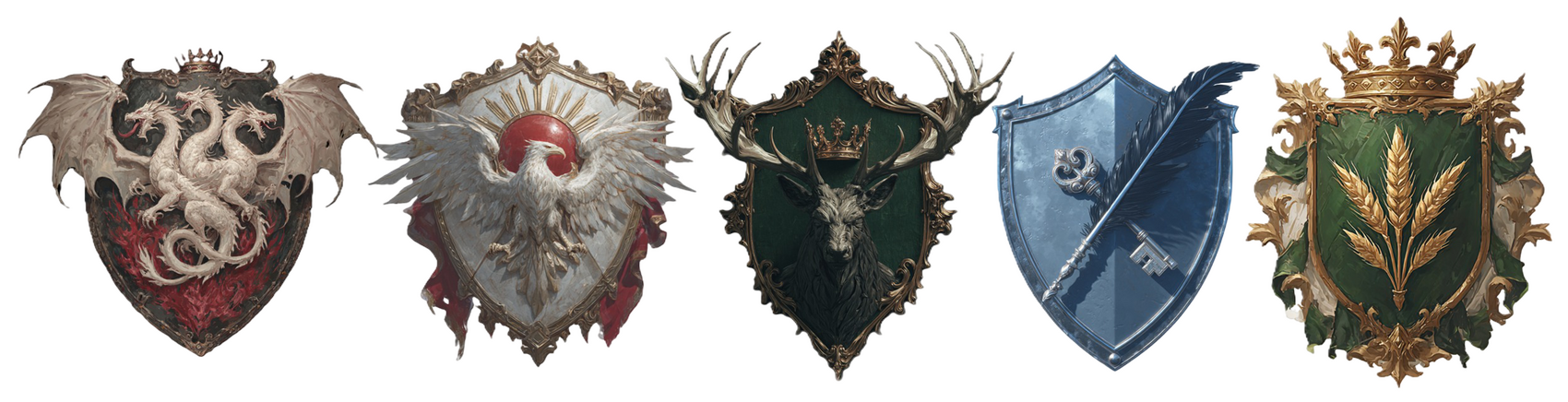
A list of the ruling House Helyrion, the major High Blood Houses of the Empire of Gyrok, and their significant sworn houses, provincial powers, and imperial vassals follows.
Imperial Dynasty
House Helyrion of Gyrokhal
Imperial Dynasty of the Imperial Heartlands, ruling the Empire of Gyrok from the Dragon Throne within the Whitefire Palace. Known as the Dragon Sovereigns, House Helyrion rules through dragon-blood legitimacy, imperial law, military dominance, sacred ceremony, and the belief that their blood alone carries the natural right to command mankind and dragons. Led by Emperor Vaerion III Helyrion, whose heir is Crown Prince Verron Helyrion.
The sigil of House Helyrion depicts a three-headed white dragon crowned in silver, wings spread in dominion, breathing crimson flame across a black field, symbolizing dragon blood, sovereign rule, imperial conquest, and the ancient authority of the Dragon Throne.
High Blood Houses
House Aerivar of Aerynd Hall
A powerful High Blood House tied to the Crown Provinces and western imperial governance, known for judges, diplomats, noble arbitration, high court officials, and the management of imperial griffin orders serving the Dragon Throne. House Aerivar presents itself as polished, disciplined, civilized, and necessary to the empire’s legal and ceremonial authority. Led by Lord Avael Aerivar, whose heir is Vaelor Aerivar.
The sigil of House Aerivar depicts a silver eagle rising before a red dawn, symbolizing high vision, noble vigilance, imperial law, and the belief that true power must stand above disorder.House Verathyr of Ironmere Hold
A severe High Blood House of the Eastern Marches, ruling cold northern military territories in the emperor’s name from Ironmere Hold and through the military authority of Gyrovhar. House Verathyr is known for fortress roads, northern garrisons, harsh discipline, old blood pride, and the brutal order required to govern the marching lands. Led by Lord Garric Verathyr, whose heir is Darric Verathyr.
The sigil of House Verathyr depicts a black crowned stag with silver antlers on a field of deep green, symbolizing endurance, northern pride, martial discipline, and old kingship bent beneath imperial rule.House Skandor of Charterfall Keep
A dominant High Blood House of the Administrative Territories, ruling through law, records, taxation, succession ledgers, bloodline registries, noble contracts, and sealed imperial decrees. From Charterfall Keep and the archive centers of Ledgerhold, House Skandor controls the written machinery that legitimizes, binds, or destroys noble power. Led by Lord Oren Skandor, whose heir is Kal Skandor.
The sigil of House Skandor depicts a pale key crossed with a black quill on blue-gray, symbolizing records, contracts, law, inheritance, sealed authority, and the power to legitimize or erase noble blood.House Morcant of Morcant Spire
A feared High Blood House seated at Morcant Spire, known for imperial intelligence, secret policing, informants, coded dispatches, blackmail archives, prison interrogators, and quiet disappearances. House Morcant governs through secrets rather than banners, making it one of the most hated and dangerous houses in Gyrok’s courtly order. Led by Lord Varyn Morcant, whose heir is Deth Morcant.
The sigil of House Morcant depicts a golden serpent coiled around a black crown, symbolizing intelligence, secrecy, blackmail, hidden rule, and the belief that wisdom itself is dominion.House Vaelrith of Vaelrith Court
A prestigious High Blood House seated at Vaelrith Court near the Imperial Heartlands, known as one of the empire’s greatest marriage houses. House Vaelrith wields influence through blood purity, court etiquette, dynastic alliances, beauty, succession politics, and nearness to Helyrion legitimacy without claiming the Dragon Throne itself. Led by Lord Caem Vaelrith.
The sigil of House Vaelrith depicts a white moon over a crimson chalice, symbolizing blood purity, marriage politics, courtly beauty, hidden influence, and the closeness of their line to House Helyrion.
Provincial High Houses
House Taegor of Goldmere Court
A wealthy Provincial High House of the Southern Grain Territories, ruling from Goldmere Court and controlling the grainlands, river tolls, harvest ledgers, irrigation routes, storage rights, and imperial food supply chains that keep the armies of Gyrok alive. Martial houses may mock Taegor softness, but no legion marches far without Taegor bread. Led by Lord Harvin Taegor, whose heir is Ser Dalen Taegor.
The sigil of House Taegor depicts three golden wheat-stalks beneath a bronze crown, symbolizing grain, tribute, agricultural wealth, and the truth that the field feeds the throne.House Stonevar of Stonewake
A stern Provincial High House and Imperial Naval House of the Eastern Marches, seated at Stonewake along the northeastern coast where the cold waters of the Stone Deep meet one of the empire’s most important military harbors. House Stonevar is known for coastal patrols, naval troop movements, lighthouse beacons, harbor chains, cliffside watch posts, cold-water supply fleets, and the grim duty of guarding the waters surrounding the Deep Caverns. Loyal more to service and survival than courtly pageantry, the Stonevars are respected for discipline, seamanship, and vigilance along a coastline few others wish to defend. Led by Lord Maeron Stonevar, whose heir is Corren Stonevar.
The sigil of House Stonevar depicts a white sea-tower above a dark blue wave, watched by a silver star, symbolizing fortified harbors, coastal vigilance, cold-water duty, and the watchful strength needed to stand against the deep.House Dunmaer of Dunmaer Bastion
An old Provincial High House and Imperial Watch House of the Crown Provinces, seated at Dunmaer Bastion along the southern highland coast where beacon towers overlook the dark sea roads below the cliffs. House Dunmaer is known for coastal watch duty, signal fires, sea-road defense, cliff patrols, warning ledgers, and the protection of imperial passage through isolated coves and dangerous waters approaching the central imperial lands. Severe, patient, and wind-beaten, the Dunmaers are defined by generations of waiting for dangers that may arrive only once in a lifetime but must never be missed. Led by Lady Meratha Dunmaer, whose heir is Odrik Dunmaer.
The sigil of House Dunmaer depicts a silver watchtower above black cliffs and a dark blue sea, symbolizing beacon vigilance, coastal defense, sleepless duty, and the lonely discipline of guarding the empire’s shores.
Provincial Houses
House Thornyr of Thornyr Bastion
An ancient martial house of the northern imperial roads and fortified borderlands, seated at Thornyr Bastion and bound to the defense of old walls, military passes, watch posts, and harsh oath-bound roads leading between the Imperial Heartlands and the wider empire. House Thornyr is grim, traditional, and severe, believing order survives only through blood, discipline, and sacrifice. Led by Lord Garond Thornyr, whose heir is Ser Branik Thornyr.
The sigil of House Thornyr depicts a black thorned branch wrapped around a silver spear, symbolizing border defense, blood duty, old vows, martial sacrifice, and the walls that hold back disorder.House Rookhar of Rookhar Aerie
A proud Provincial House seated at Rookhar Aerie, holding high passes, cliff roads, mountain signal towers, and messenger routes through the difficult uplands and imperial road networks. House Rookhar is useful, stubborn, and difficult to command, prized for controlling movement through hard country where imperial authority depends on local knowledge. Led by the Lord of Rookhar Aerie.
The sigil of House Rookhar depicts a black rook flying over a white mountain, symbolizing cliff roads, high passes, messenger routes, difficult loyalty, and memory held in stone.House Caldrane of Port Avaros
An Imperial Maritime House seated at Port Avaros, controlling shipping contracts, harbor taxes, naval levies, prisoner transport, coastal tolls, and sea-lane enforcement. House Caldrane measures loyalty through profit, protected ledgers, reliable waters, and whatever arrangement keeps its ships moving beneath imperial authority. Led by the Lord of Port Avaros.
The sigil of House Caldrane depicts a silver ship beneath a storm-black star, symbolizing sea routes, harbor power, maritime contracts, prisoner transport, and loyalty guided by profit.
Banner Houses
House Brandovar of Brandovar Fortress
An Imperial Banner House of the Eastern Marches, seated at Brandovar Fortress along the principal military roads stretching toward Crowvale, the Halvorn Plains, Rivermarch, and Gyrovhar. House Brandovar rose through fortress command, siegecraft, military engineering, and loyal service in rebellion-torn provinces, trusting stone, roads, garrisons, and supply lines more than courtly promises. Led by the Lord of Brandovar Fortress.
The sigil of House Brandovar depicts a red tower burning beneath a gold crown, symbolizing fortress command, siegecraft, loyal service, and flame standing before ruin.House Skarneth of Skarnhook
An Imperial Sea-Banner House of the Outer Isles, ruling the brutal cliff-carved stronghold of Skarnhook across the freezing waters of the Imperial Markandal. House Skarneth is feared for naval violence, raiding harbors, smuggling suppression, boarding actions, hostage-taking, and brutal enforcement along dangerous waters where mainland law often needs a harder hand. Led by Lord Ryk Skarneth, whose heir is Ser Ivek Skarneth.
The sigil of House Skarneth depicts a hooked black blade over a red wave, symbolizing coastal violence, naval enforcement, boarding actions, blood in the water, and strength taken from storm and fear.
House Barrowen of Barrowfield
A wealthy Banner House of the Southern Grain Territories, sworn to House Taegor and seated at Barrowfield amid some of the richest agricultural lands in the Empire of Gyrok. House Barrowen governs vast grain estates, mill villages, cattle meadows, granary compounds, harvest carts, labor levies, and river-loading stations that help feed both the imperial legions and Gyrokhal itself. Though often overlooked by older martial houses, the Barrowens command the fields, mills, tenants, storehouses, and tribute routes without which the empire would starve. Led by Lord Harren Barrowen, whose heir is Tavric Barrowen.
The sigil of House Barrowen depicts a bronze plough beneath three black sheaves upon a field of gold, symbolizing harvest wealth, tribute fields, endurance, and the truth that what is sown beneath imperial rule must still survive the winter.House Vhassar of Vhassar Watch
A minor Banner House and Imperial Knightly House of the Imperial Heartlands, sworn directly to House Helyrion and long attached to the service of Silverflame Court. Seated at Vhassar Watch, a fortified watchtower-manor near the old northern military roads outside Gyrokhal, House Vhassar is known for household knights, sworn swords, road wardens, signal captains, escort commanders, and military retainers trusted to guard imperial blood during travel, unrest, and frontier assignments. Though dismissed by ancient nobles as tower-born soldiers with a noble name, the Vhassars are respected by warriors for endurance, silence, loyalty, and the belief that duty means remaining at one’s station until dawn. Led by Lord Vaedrik Vhassar, whose heir is Ser Calven Vhassar.
The sigil of House Vhassar depicts a black signal tower burning with silver flame upon an ash-gray field, symbolizing watch posts, winter roads, sworn service, signal fire, and loyalty that holds until the dark has passed.
Factions
Dawn Loyalists — Traditionalists who support absolute Helyrion rule and believe the empire can only survive through discipline, fear, obedience, and the sacred authority of dragon blood. They defend the Dragon Doctrine, honor the old imperial ceremonies, and see weakness toward provincial demands as the first step toward treason.The Provincial Compact — an alliance of provincial nobles, regional governors, and old territorial houses who want greater autonomy from Gyrokhal without openly naming it rebellion. They speak in careful language about efficiency, local need, ancient privilege, and provincial stability, but beneath that restraint lies resentment toward imperial taxes, hostage wards, and Helyrion interference.Iron Legates — military officers, legion commanders, fortress lords, and hardline strategists who believe court politics are weakening the empire from within. They argue that noble vanity, marriage schemes, legal delays, and ceremonial weakness have made Gyrok vulnerable, and some quietly believe the empire should be ruled through martial command until stability is restored.The Blood Court — highborn families obsessed with lineage, marriage politics, dragon-blood proximity, inheritance, noble purity, and the prestige of ancient descent. They wield power through betrothals, births, succession claims, accusations of tainted blood, and the careful placement of daughters, sons, wards, and spouses near the Dragon Throne.Quiet Ledgers — administrators, tax masters, scribes, debt keepers, charter officials, legal ministers, and record-holding families who control the empire through documents rather than swords. They shape power through tax rolls, debt records, marriage contracts, inheritance rulings, land charters, travel permits, and the quiet truth that what is not written may as well not exist.
Currency & Trade
Currency in the Empire of Gyrok is regulated by imperial weight, metal purity, and the Helyrion seal. The standard imperial currency is known as Dragonweight, a state-controlled coinage system designed to bind trade, taxation, tribute, and noble wealth beneath the authority of Gyrokhal.Imperial Suns — gold coins used for noble debts, military contracts, land purchases, tribute payments, dynastic settlements, and high-value trade. Each coin bears the image of the reigning emperor on one side and the crowned three-headed dragon of House Helyrion on the other, making every major transaction a reminder of imperial authority.Silver Talons — the backbone of daily imperial commerce, commonly used for wages, rents, market exchange, tolls, provincial tax payments, merchant contracts, and military provisioning. Most towns, ports, inns, and road stations measure ordinary value through Silver Talons.Copper Scales — small coinage used by commoners for food, drink, lodging, simple tools, repairs, ferry passage, village markets, and other modest expenses. To most common folk, Copper Scales are the coins they touch most often, while Imperial Suns remain symbols of noble wealth rather than daily life.Tribute Bars — stamped metal bars used by provinces, mines, wealthy houses, ports, and major guild interests for large tax payments owed to Gyrokhal. These are not common market currency, but instruments of imperial accounting, often weighed, sealed, guarded, and recorded by tax officials before being transported along imperial roads or rivers.Foreign, old, or provincial coinage is accepted only by weight and purity, not by face value. Clipped, shaved, false-stamped, or dragon-forged counterfeit coinage is treated as a severe imperial crime, since tampering with currency is considered an attack on the order of the empire itself.Trade flows through imperial roads, rivers, ports, grain lands, military supply lines, chartered markets, toll stations, and dragon-protected routes. In Gyrok, coin is never only coin; it is law, tribute, loyalty, and proof that even commerce moves beneath the shadow of the Dragon Throne.
Laws
Imperial law in the Empire of Gyrok is severe, hierarchical, and designed to preserve order, tribute, bloodline legitimacy, noble obedience, and the absolute authority of House Helyrion. Law is not treated as separate from imperial power; it is one of the Dragon Throne’s sharpest instruments.The Law of the Dragon Throne
declares that all land, roads, rivers, mines, ports, fortresses, taxes, and noble titles ultimately exist beneath the authority of the emperor. Provincial lords may govern in the emperor’s name, but they do not possess power independent of Gyrokhal.The Law of Imperial Treason
makes rebellion, conspiracy against House Helyrion, obstruction of imperial messengers, sheltering declared traitors, forging imperial seals, or raising arms without sanction punishable by death, confiscation, exile, imprisonment, or the destruction of a family line.The Law of Blood Recognition
governs noble legitimacy, inheritance, marriage contracts, bastardy claims, hostage wards, and succession disputes. Noble bloodlines must be recorded and recognized by imperial officials to hold lawful rank, inherit titles, or claim sanctioned authority.The Law of Tribute
requires provinces, houses, cities, temples, ports, mines, and grainlands to provide taxes, coin, food, soldiers, labor, livestock, ore, timber, ships, or materials to Gyrokhal. Failure to pay tribute may be treated as disobedience, fraud, or rebellion.The Law of Roads
protects imperial roads, bridges, courier routes, waystations, military passages, and sanctioned travelers under imperial protection. Banditry, sabotage, false tolls, bridge-burning, attacks on couriers, or interference with military movement are punished harshly.The Law of Coin
forbids clipping, shaving, counterfeiting, false stamping, or melting imperial currency without sanction. False coinage is considered an attack on imperial order because the emperor’s seal, weight, and purity define lawful exchange.The Law of Dragon Sanctity
forbids commoners, lesser nobles, merchants, foreign envoys, unauthorized priests, and unrecognized officials from approaching dragon sanctums, dragon eggs, dragon bones, dragon relics, living dragons, or sealed Helyrion flame chambers without imperial permission.The Law of Noble Hostage
protects the imperial custom of taking noble children as court wards. Publicly, these children are honored guests educated near power; legally, they are guarantees of family obedience, useful against rebellious houses and wavering provincial lords.The Law of Provincial Peace
forbids private wars between noble houses unless sanctioned by imperial decree. In practice, powerful houses still feud through assassins, marriage traps, legal accusations, hostage pressure, border incidents, and carefully deniable violence.
Faith
The dominant public faith of the Empire of Gyrok is centered on imperial hierarchy, sacred blood, dragonfire, conquest, and the divine ordering of rule. Religion in the empire does not stand apart from politics; it reinforces the belief that power must descend from above, that obedience preserves civilization, and that rebellion is not only treason but spiritual disorder.The Flame of Dominion is the formal court religion of Gyrok. It teaches that power must descend from the highest blood, that mankind requires hierarchy to survive, and that House Helyrion was chosen by dragonfire to rule. To its priests and supporters, the empire is not merely a conquest state, but a sacred structure built around blood, flame, law, and obedience.The faith does not worship dragons as simple gods. Instead, dragons are treated as ancient witnesses, sovereign beasts, and living proofs that Helyrion blood is legitimate. Their recognition of House Helyrion is viewed as sacred evidence that the Dragon Throne stands above ordinary kingship, noble ambition, and provincial custom.Priests of the Flame of Dominion bless imperial heirs, witness blood oaths, preserve dragonfire rites, sanctify conquest, guard sacred flame chambers, and condemn rebellion as a sin against order. They appear at coronations, succession rites, military victories, dynastic marriages, court ceremonies, and public acts of imperial judgment.In distant provinces, older local faiths still survive beneath imperial ritual. Some conquered peoples publicly honor the Flame of Dominion while privately praying to older gods, ancestors, rivers, mountains, harvest spirits, sea powers, or household dead. To Gyrokhal, such private customs are tolerated only so long as they do not challenge the Dragon Throne, weaken tribute, or deny the sacred authority of House Helyrion.
Eras of the Empire
The Founding Age — IY 1 to IY 120
The Founding Age marks the rise of the first Helyrion emperors, the formation of the Dragon Throne, the first imperial conquests, and the binding of early noble houses beneath Helyrion rule. This was the age when Gyrok changed from a royal dominion into a true empire, as conquest, blood oaths, dragonfire rites, and early imperial law began shaping the foundations of Helyrion authority.The Golden Dominion — IY 121 to IY 430
The Golden Dominion was the height of imperial power. Gyrok ruled much of Averon through roads, armies, tribute, noble hostages, marriage treaties, dragon-blood doctrine, and the feared presence of dragons. This was the age when House Helyrion seemed untouchable, when the empire’s roads expanded, its provinces bent beneath imperial administration, and the Dragon Throne stood as the unquestioned center of power.The Age of Iron Peace — IY 431 to IY 660
The Age of Iron Peace was a long period of forced stability. Rebellions were crushed quickly, noble houses were watched carefully, and the empire hardened into an administrative and military machine. The peace was real, but it was maintained through fear, surveillance, hostage wards, legal control, military readiness, and the constant reminder that imperial order was stronger than provincial will.The Late Imperial Era — IY 661 to Present
The Late Imperial Era is the current and most tumultuous period of Gyrok’s rule. The empire remains vast, wealthy, and powerful, but corruption, succession disputes, provincial resentment, religious division, noble ambition, court factionalism, and military rivalry have begun weakening the imperial structure beneath its ceremonial grandeur. House Helyrion still rules from the Dragon Throne, but the empire’s strength is increasingly tested by the very houses, laws, armies, and traditions that once held it together.
Dragons
Dragons in the Empire of Gyrok are ancient sovereign beasts tied most strongly to House Helyrion, the Dragon Throne, the Sanctum of the Veyrakar, and the imperial belief that dragon blood grants the natural right to rule. They are not treated as common war animals, nor as simple mounts. In Gyrothian belief, dragons are older than mankind, older than crowns, and closer to the raw order of the world than any mortal dynasty except the Helyrions themselves.Imperial doctrine teaches that dragons recognize Helyrion blood as sovereign. This belief is the foundation of the Dragon Doctrine, which claims that dragons submit only to rightful blood, never to chains. Because of this, every dragon connected to the empire is more than a creature; each one is a political symbol, a religious proof, a military threat, and a living argument that House Helyrion was born to rule.Most dragons known to the empire are housed, studied, guarded, or recorded through the Sanctum of the Veyrakar, the hidden dragon stronghold along the northern coast of the Imperial Heartlands. There, the Veyrakar serve as dragon keepers, lore preservers, ritual attendants, bloodline witnesses, and handlers of the oldest dragon traditions. The Great Seers interpret dragon dreams, blood omens, flame patterns, and signs of whether a dragon has accepted or rejected a Helyrion.Dragons are rarely seen by common people. Most citizens of Gyrok will live and die without ever seeing one in the flesh. They know dragons through banners, coins, temple sermons, imperial processions, carved monuments, old scars in the land, and the fear in nobles’ voices when a dragon’s name is spoken. A single rumor that a dragon has stirred near Gyrokhal can silence provincial defiance for months.Though House Helyrion claims dragons obey by sacred blood, the truth is more complicated. Some dragons are deeply bonded to individual Helyrions. Some tolerate the empire because ancient rites and old blood compel their attention. Some sleep for decades beneath stone. Some ignore imperial summons entirely. Some are too old, wounded, proud, or strange to be commanded at all. The most dangerous secret of the era is simple:House Helyrion controls dragons less completely than the empire wants the world to believe.
Known Dragons of the Empire
Maerax, the Black Sovereign
Bonded to Crown Prince Verron HelyrionMaerax is the most politically important dragon currently known to the empire because he is bonded to Crown Prince Verron Helyrion, the heir to the Dragon Throne. He is a massive black dragon with jagged crown-like horns, dark iron scales, ember-lit throat markings, and wings broad enough to cast a battlefield into shadow. His flame burns deep crimson with black smoke, hot enough to melt armor and leave stone glassed beneath his breath.Maerax is not gentle, ceremonial, or easily displayed. He is dominant, territorial, and violently intelligent, responding to Verron with a loyalty that looks less like obedience and more like recognition. His bond with Verron has become one of the strongest arguments for Verron’s legitimacy, especially among hardline Dawn Loyalists and military traditionalists who believe the next emperor must be proven through dragon acceptance, not merely birth order.To the court, Maerax is both blessing and threat. His bond strengthens Verron’s claim beyond politics, but it also makes Verron more dangerous than any ordinary heir. Courtiers whisper that Maerax does not bow to House Helyrion as a whole — only to Verron.Vhaelyx, the Whitefire Elder
Associated with Emperor Vaerion III HelyrionVhaelyx is an ancient pale dragon tied to the imperial line and often associated with Emperor Vaerion III Helyrion, though whether he is truly bonded to Vaerion or merely bound to the Dragon Throne itself is debated in careful whispers. His scales are white-gold and frost-pale, with faint silver ridges along his neck and wings like torn ceremonial silk. His fire burns pale, almost white, giving rise to countless courtly claims that the Whitefire Palace itself was blessed by his flame.Vhaelyx is rarely seen outside sacred ceremonies and imperial rites. He is old, slow to anger, and terrifyingly still, often described as watching mankind the way a mountain watches passing weather. When he appears, it is usually during the highest state ceremonies: imperial succession affirmations, sacred dragonfire rites, great oaths, or moments when House Helyrion must remind the empire that its authority is not merely human.Azhurakar, the Bronze Warden
Kept within the Sanctum of the VeyrakarAzhurakar is a bronze-scaled dragon kept deep within the Sanctum of the Veyrakar, where he serves as one of the great warding dragons of the northern sanctum. His scales are dark bronze edged with green-black patina, and his eyes glow like molten copper beneath ancient brow ridges. He is heavily scarred along one side of his neck and shoulder, suggesting wounds from wars or bindings no court record openly explains.Azhurakar is not bonded to any living Helyrion in a simple personal sense. Instead, he is tied to the sanctum itself, its wards, its dragon halls, and the rites performed by the Veyrakar. He is considered one of the dragons most trusted by the Great Seers, though “trusted” among dragons does not mean tame. His presence is believed to help guard the deepest chambers where dragon eggs, old bones, bloodline tablets, and forbidden flame rites are preserved.He is said to become restless when succession grows unstable, when bloodlines are falsified, or when oaths sworn in dragonfire are broken.Syraevyth, the Silver Mourner
A prophetic dragon of the VeyrakarSyraevyth is a silver-white dragon associated with dreams, omens, mourning rites, and prophetic disturbance. She dwells within the colder upper caverns of the Sanctum of the Veyrakar, where moonlight and sea mist sometimes reach through broken cliff openings. Her scales shimmer between silver, white, and faint blue, and her wings are thinner and more elegant than those of the larger war dragons.The Great Seers consider Syraevyth one of the most important dragons in the empire, not because she is the strongest, but because she dreams. Her movements, cries, periods of silence, and refusal to eat are all recorded by Veyrakar attendants as possible omens. When Syraevyth screams in her sleep, sealed letters are sent to Gyrokhal. When she coils with her head facing south, court astrologers argue for weeks over what disaster she has sensed.She has no public role and is almost unknown outside the Dragon Court, but those who know of her fear her deeply. She is believed to sense bloodline decay, false heirs, broken oaths, and approaching catastrophe.Draugrath, the Ashen Chain
A dangerous elder restrained beneath the SanctumDraugrath is one of the most feared dragons still known to the Veyrakar. He is an immense ash-gray dragon with cracked charcoal scales, broken horn ridges, and chains of dragon-forged iron set into the deepest stone of the sanctum caverns. Imperial doctrine does not publicly admit that any dragon is chained, because such a truth contradicts the claim that dragons submit only to rightful blood. For that reason, Draugrath’s existence is one of the most dangerous secrets in the empire.He is not considered loyal. He is not displayed. He is not invoked in ceremony. The Veyrakar records describe him as ancient, wrathful, and wounded by old imperial rites that were never meant to be repeated. His flame is said to burn dull orange and black, leaving behind choking ash rather than clean fire. Some believe he once rejected a Helyrion claimant. Others believe he was captured during the early conquests and hidden away because killing him proved impossible.Draugrath is the living contradiction at the heart of the Dragon Doctrine. If dragons only submit to rightful blood, then why does one remain chained beneath Helyrion stone?Kaelthoryn, the Red War-Flame
A dragon tied to the Imperial LegionsKaelthoryn is a red-scaled war dragon occasionally used in the most extreme demonstrations of imperial military power. He is housed between the Sanctum and hidden military grounds near the Imperial Heartlands, never kept too close to ordinary garrisons for long. His body is muscular and brutal rather than elegant, with thick horn plates, scarred wings, and a temper that requires entire teams of Veyrakar handlers, priests, and legion officers to manage.Kaelthoryn is not bonded to a single prince in the way Maerax is bonded to Verron. Instead, he responds to sanctioned Helyrion blood rites, dragonfire commands, and battlefield signals prepared by the Veyrakar. When he is brought to war, it is never casually. His appearance means the Dragon Throne intends to end resistance, not negotiate with it.The empire rarely deploys him because every use of a war dragon creates fear even among loyal provinces. A dragon can win a battle, but it can also remind nobles that the empire’s peace is ultimately built on terror.Orryxa, the Deep-Winged
A sea-haunting dragon near the Imperial MarkandalOrryxa is a dark blue-black dragon associated with the freezing waters of the Imperial Markandal, the northern coast, and the sea routes between the mainland and the Outer Isles. She is rarely seen in full, more often glimpsed as a vast shape beneath stormwater, a winged shadow vanishing into fog, or a scaled back breaking the surface near shipwrecks.Unlike the dragons of the Whitefire Palace or the Sanctum, Orryxa does not seem fully contained by Helyrion authority. The empire claims she is one of its sea wardens, tied to the Dragonbound Sentinels and northern naval rites. Sailors are less certain. Some believe she guards the waters. Others believe she hunts there. House Skarneth captains tell stories of her passing beneath ships in silence, turning the sea cold enough to freeze ropes stiff.The Veyrakar occasionally record sightings of Orryxa near the Dragonbound Sentinels, especially during storms, celestial alignments, or strange movement beneath the sea.Thamiorix, the Gold-Crowned Flame
A ceremonial dragon of the Dragon CourtThamiorix is a gold-scaled dragon used primarily for imperial ceremony, noble awe, and controlled public spectacle. He is smaller than Maerax or Kaelthoryn, but magnificent to behold, with bright golden scales, crown-like horns, and flame that burns clean orange-gold. He is the dragon most likely to be seen during carefully managed imperial displays, including rare Dragon Processions, great feasts of victory, and sacred appearances before gathered nobles.Thamiorix is chosen for ceremony because he is more predictable than most dragons, though “predictable” only means that he is less likely to incinerate a crowd without provocation. His presence is used to remind lesser nobles, foreign envoys, provincial leaders, and common spectators that dragons still stand with House Helyrion.Among hardline courtiers, Thamiorix is beloved as a symbol of imperial beauty. Among dragon keepers, he is treated with careful caution, because ceremonial dragons can become vain, territorial, and violently offended by disrespect.
Dragon eggs & hatchlings
Dragon eggs are among the most restricted treasures in the empire. They are kept within sealed chambers of the Sanctum of the Veyrakar, watched by dragon keepers, flame priests, bloodline officials, and Great Seers. The existence of a dragon egg is considered a matter of imperial security. A noble house that even attempts to steal, hide, purchase, or falsely claim a dragon egg risks extermination under the Law of Dragon Sanctity.Dragon eggs do not hatch on simple command. The Veyrakar believe they respond to blood proximity, heat, ancient flame rites, and moments of great political or spiritual pressure. Some eggs remain dormant for generations. Others crack unexpectedly when a Helyrion child is born, when an heir is named, when a dragon dies, or when the empire enters a period of instability.A dragon hatchling is not automatically bonded. The Choosing, as the Veyrakar call it, is dangerous and unpredictable. Some hatchlings reject every claimant. Some attach themselves to a single child. Some kill handlers before they ever accept a bond. A successful bond between a dragon and a Helyrion is treated as sacred proof of legitimacy, but a failed Choosing can ruin reputations, succession hopes, or entire branches of the bloodline.
Dragon Bonds
A true dragon bond is rare even among Helyrions. Many members of House Helyrion can stand near dragons without immediate death, but only a few are truly recognized. Recognition is different from obedience. A dragon may tolerate, watch, test, or follow a Helyrion without being fully bonded.A true bond usually appears through repeated signs: the dragon allows proximity without handlers, answers to the Helyrion’s voice, mirrors the Helyrion’s anger, reacts to their pain, and refuses commands from others. Strong bonds can become politically dangerous because they elevate one Helyrion above the rest of the family.
Griffins
Griffins are among the rarest and most honored creatures of the Empire of Gyrok, powerful aerial predators associated with height, vigilance, noble command, and imperial authority. Though they do not hold the same sacred supremacy as dragons, griffins are still regarded as creatures of immense prestige, especially among the western highland provinces where their oldest aeries are maintained.To the imperial mind, dragons represent conquest, blood, fire, and the divine authority of House Helyrion, while griffins represent discipline, judgment, watchfulness, highborn service, and the empire’s ability to command the skies beneath the Dragon Throne.Unlike dragons, which are tied directly to Helyrion blood doctrine and the ancient legitimacy of the Dragon Emperors, griffins are not considered sovereign beasts of divine rulership. They are dangerous, proud, intelligent, and difficult to master, but they can be trained under strict imperial systems. Their use requires generations of discipline, specialized handlers, hereditary riders, and aeries built in high crags, fortified towers, mountain halls, and cliffside strongholds.Griffins do not submit easily to common soldiers or ambitious nobles. They respond best to long familiarity, firm command, careful breeding, and riders raised around them from youth. A poorly trained rider is more likely to be thrown from the sky than obeyed.
House Aerivar & the purpose of griffins
Within the empire, House Aerivar is the noble family most strongly associated with griffins. A High Blood House seated at Aerynd Hall, House Aerivar oversees the largest griffin aeries in the empire outside the Sanctum of the Veyrakar itself. Their sigil, a silver eagle rising before a red dawn, and their words, Above All Storms, reflect their ancient connection to aerial command, western imperial law, and the disciplined mastery of the upper skies.House Aerivar is one of the oldest noble families bound to the Helyrion emperors. They are known for producing imperial judges, commanders, diplomats, high court officials, magistrates, scribes, royal envoys, and griffin riders in service to the Dragon Throne. Proud, polished, and politically disciplined, the Aerivars believe they are natural stewards of western imperial law.House Aerivar maintains approximately one hundred and thirty griffins across its various imperial aeries, though only a fraction are trained for warfare or long-range military service at any given time. Aerivar griffins are regarded as symbols of imperial prestige, discipline, and heavenly authority beneath House Helyrion.Aerivar griffin riders serve as imperial messengers, aerial scouts, military outriders, and honored escorts for Dragon Court envoys traveling between the provinces of Averon. In war, they are used for reconnaissance, rapid communication, battlefield signaling, mountain patrols, pursuit of fleeing enemies, and the protection of imperial roads and highland passes.Griffins are not deployed like common cavalry, nor are they treated as expendable war-beasts. A trained griffin is a living symbol of imperial prestige, and the death of one is considered a serious loss of wealth, bloodline work, and military capability.Many griffins are used for breeding, ceremonial escort, message flights, provincial patrols, or the training of young riders. The finest Aerivar griffins are reserved for elite riders, high imperial envoys, and military commanders trusted by the Dragon Court. Their existence allows the empire to project authority across difficult terrain where roads, horses, and infantry are too slow to answer sudden threats.
Griffins & Dragons
Despite their importance, griffins remain politically secondary to dragons. No griffin rider, no matter how skilled, can claim the same sacred status as a dragon-bonded Helyrion. This distinction is fiercely protected by imperial doctrine. Griffins may serve the empire, but dragons define it.For this reason, House Aerivar holds a prestigious yet carefully bounded position within Gyrok. They are honored, necessary, and admired, but never permitted to rival House Helyrion’s dragonborn supremacy. Griffins strengthen imperial authority, but they do not replace the divine terror of dragonfire.Even so, the symbolism of griffins gives House Aerivar unusual influence. Their command of imperial aeries makes them indispensable to provincial governance, military communication, and high court diplomacy. A message carried by Aerivar wings can cross mountains faster than any rider on land, and an Aerivar escort above a noble procession signals that the Dragon Throne has placed visible trust in the mission.
History/Lore
This pertains to any notable lore or history set during the time of the Empire of Gyrok's rule over Averon.
House Caervorn
House Caervorn was an ancient northern dynasty that ruled from Caervhal, a fortress-city built deep in the northern highlands beyond the older imperial roads. The family claimed descent from the stag-crowned kings, a pre-imperial royal line said to have ruled parts of northern Averon before the rise of the first Helyrion emperors.For generations, House Caervorn existed as a dangerous but tolerated vassal of Gyrok. Its lords bent the knee in public ceremony, sent tribute when required, and accepted imperial oversight when forced, but they never fully abandoned their old royal identity. Within Caervhal, the house preserved forbidden genealogies, pre-imperial law tablets, old crowns, and songs that remembered the Helyrions not as sacred rulers, but as dragon-backed conquerors.This made House Caervorn a continual concern for Gyrokhal. Unlike ordinary rebellious houses, Caervorn did not simply seek more land, lower tribute, or provincial privilege. Its existence represented an older claim to rule that stood outside the Dragon Doctrine.House Caervorn should not be confused with House Verathyr despite the similarity in heraldry. Though both houses were northern in origin and associated with cold military lands, they occupied very different positions within the empire. House Verathyr was a recognized High Blood House of the Eastern Marches, seated around Ironmere Hold and Gyrovhar, and remained legally loyal to House Helyrion during the war. House Caervorn, by contrast, was an older pre-imperial royal bloodline seated at Caervhal in the far northern highlands, claiming descent from stag-crowned kings whose authority predated the Dragon Throne. Verathyr served the empire through military command; Caervorn challenged the empire through forbidden royal legitimacy.
War of the Black Antler
The War of the Black Antler was a major imperial war fought between the Empire of Gyrok and House Caervorn, an ancient northern royal bloodline that challenged the supremacy of House Helyrion and the Dragon Throne. The conflict lasted from IY 646 to IY 653 and is remembered as one of the bloodiest wars of the late imperial period.The war ended with the destruction of House Caervorn, the burning of its ancestral fortress-city of Caervhal, and the formal erasure of the house from lawful nobility under the Decree of Antler Ash.The War
The war began when Lord Arveth Caervorn, later called the Black Antler King by his supporters, refused to send his eldest grandson to the Whitefire Palace as a noble hostage ward. The refusal was treated by Gyrokhal as a direct insult to imperial authority.Rather than submit, Arveth summoned northern banner houses, mountain clans, fortress captains, and discontented military families who resented Helyrion dominance. Caervorn envoys spread the claim that dragon blood did not make a ruler sacred, but merely made conquest easier. To the Dragon Court, this was not a minor rebellion. It was ideological treason.House Caervorn’s forces moved quickly through the northern passes, seizing watchtowers, cutting the High Pass Roads, and taking several imperial forts before the empire could fully respond. The Caervorn host fought beneath black antler banners and made heavy use of winter terrain, mountain ambushes, and fortress warfare. The early years of the war were marked by several imperial humiliations. Imperial legions struggled in the frozen passes, supply lines collapsed under snow and sabotage, and Caervorn riders repeatedly vanished into the highlands before they could be forced into open battle.As the war expanded, House Verathyr was ordered to prove its loyalty by leading campaigns against northern houses with old ties to Caervorn blood. This created lasting tension within the Eastern Marches, as Verathyr soldiers were forced to fight men who shared similar customs, burial rites, and memories of pre-imperial northern rule.House Morcant also rose in importance during the conflict, expanding its intelligence networks to hunt Caervorn sympathizers across Gyrokhal, Ledgerhold, and the Crown Provinces. Meanwhile, House Skandor weaponized imperial law by placing Caervorn marriages, inheritances, blood claims, and sworn oaths under legal review.The Siege of Caervhal
The decisive event of the war was the Siege of Caervhal in IY 651. Imperial armies surrounded the fortress-city for nearly seven months, but Caervhal’s black stone walls, hidden mountain passages, and fanatical defenders made it nearly impossible to take by ordinary siegecraft.When the siege stalled, the Dragon Court authorized the use of dragonfire. Kaelthoryn, the Red War-Flame, was brought north under sanctioned Helyrion rites. Imperial priests declared that if House Caervorn claimed a crown older than dragons, then dragons would judge the claim.Caervhal burned in stages. Its outer walls cracked beneath heat, its ice towers collapsed, its stone gates glowed red, and the lower city was reduced to ash and steam beneath falling snow. Lord Arveth Caervorn was captured in the inner hall beneath the remnants of his house’s black antler crown. He refused to kneel and was executed under the Law of Imperial Treason.Aftermath
The war officially ended in IY 653 with the Decree of Antler Ash. The decree stripped House Caervorn of all lawful titles, lands, heraldry, and noble recognition. Its sigil was banned, its histories were sealed, and possession of Caervorn crowns, genealogies, songs, or royal seals became a punishable offense.The surviving Caervorn lands were divided among loyal houses. Several old vassals were forced to swear new oaths beneath Helyrion banners, while suspected sympathizers were executed, exiled, or absorbed into imperial wardship. The empire declared House Caervorn extinct, though rumors persisted that some of its blood survived through hidden marriages, mountain villages, monasteries, or unrecorded hostage lines.Common Saying
“The antler rose before the dragon, and the dragon left only ash.”
The Antlered God
The Antlered God is an ancient northern deity associated with stags, roots, winter, death, memory, blood, and buried sovereignty. Imperial chroniclers dismissed the god as a primitive mountain superstition, but House Caervorn preserved his rites long after such worship had become politically dangerous.To the Caervorns, the Antlered God was not merely a forest spirit. He was regarded as an older power tied to the land itself, older than crowns, older than dragons, and older than the imperial roads that cut through northern Averon.The final rite performed beneath Caervhal was believed to have preserved Rhydan Caervorn, the last of House Caervorn, from death and age, binding him to the memory of his house and the hidden survival of the fortress-city.
The Veil
After the fall, Caervhal disappeared from imperial reach. Maps marked the fortress-city as ruined. Roads leading to it were forgotten, blocked, or misremembered. Patrols sent into the region turned back without clear reason. Travelers became lost in snowstorms, wandered in circles, or returned convinced they had found only collapsed bridges, dead trails, and empty stone.The Veil did not make Caervhal truly invisible. Instead, it bent direction, memory, weather, and fear. Outsiders might glimpse towers through snowfall, hear distant hammers, or see torchlight along the cliffs, only to lose the sight moments later and doubt what they had seen.The Veil could be crossed only by those guided by Caervorn blood, sworn loyalty, or the will of the Antlered God.Hidden Reconstruction of CaervhalInside the Veil, the remnants of House Caervorn endured.Surviving retainers, hidden descendants, mountain families, oathbound guards, and those abandoned by imperial law slowly gathered beneath Rhydan’s rule. Over the decades, Caervhal was rebuilt in secret. The outer city remained scarred and half-ruined, but the inner keep, great hall, chambers, armories, and sacred lower passages were restored first.Workers labored under guard. No one left without permission. No message traveled without Rhydan’s seal. No outsider was allowed to know that House Caervorn had begun to breathe again.By IY 716, Caervhal still remains hidden from the wider empire, but it is no longer a dead ruin. Its streets are guarded, its towers are being repaired, its halls are restored, and its people remain fiercely loyal to the last son of their fallen house as their deathless lord.
Legend of the Black Antlered Knight
In the decades following the Fall of House Caervorn, scattered stories began to spread through the northern highlands and the Eastern Marches of a mysterious armored rider known as the Black Antlered Knight. The figure was described as a lone warrior in dark plate armor, wearing an antlered helm and carrying a heavy warhammer. He was said to appear without warning during snowstorms, mountain ambushes, ruined-road attacks, and border conflicts, only to vanish before his identity could be confirmed.No official record names the Black Antlered Knight, and most imperial authorities dismissed the tales as peasant superstition, outlaw exaggeration, or old Caervorn loyalist propaganda. Some claimed he was the ghost of a dead Caervorn prince. Others believed he was a surviving knight of the fallen house, a mountain spirit, or a cursed executioner sent by the old northern gods. In taverns and villages, the stories often differed, but the details remained strangely consistent: black armor, antlered helm, winter mist, a warhammer, and no mercy for oathbreakers, slavers, bandits, or imperial agents who abused their authority.The Black Antlered Knight was most often sighted along the forgotten roads between the northern highlands and the Eastern Marches, particularly near old forest routes, abandoned watchtowers, broken imperial roads, and mountain settlements once tied to Caervorn influence. Several bandit companies were found destroyed after claiming Caervorn ruins as hideouts. Corrupt tax collectors vanished in snowbound valleys. Imperial patrols sent to investigate forbidden shrines returned with missing men and confused memories. In some accounts, kidnapped villagers, noble hostages, or lost children were returned safely after being taken by raiders, though none could clearly describe their rescuer beyond the antlered helm.Among common folk, the legend became both warning and comfort. To criminals and cruel lords, the Black Antlered Knight was a death omen. To isolated villages, he became a strange protector of the old roads. Mothers frightened children with his name when they wandered too far into the woods, while old men left offerings of bread, salt, black thread, or stag bone at boundary stones in case he passed by.The Dragon Court never treated the stories seriously in public, but certain reports were quietly sealed by House Morcant agents and imperial road-commanders. The repeated appearance of a black-antlered figure near old Caervorn territory caused unease among officials familiar with the War of the Black Antler, especially when witnesses described the knight’s armor as bearing forbidden Caervorn styling.
The Eirwyn
The Eirwyn are an ancient, nearly forgotten non-human people who inhabited the continent of Averon long before the rise of the Empire of Gyrok, before House Helyrion claimed the Dragon Throne, and before human rulers carved the land into provinces, roads, fortresses, and courts. In the present Imperial Era, most people believe the Eirwyn were only figures from old woodland stories: pale spirits who stole travelers from moonlit roads, whispered through trees, or punished oathbreakers who entered sacred groves. In truth, the Eirwyn were real, and scattered remnants of their people may still survive in places where imperial authority has never fully reached.The Eirwyn are slight, graceful beings with an ageless and unsettling beauty. Their skin ranges from pale ivory to muted ash-brown, often marked with faint natural patterns resembling roots, branches, frost-lines, stone veins, or the pale tracery of leaves. Their eyes are usually deep black, dark silver, or reflective grey, seeming to hold light rather than merely reflect it. Their hair may be white, ash-brown, black, or silver-grey, commonly worn braided with pieces of bark, smooth bone, dried leaves, small river stones, and cords made from plant fiber. They do not dress in the heavy wealth of human nobility, favoring layered garments of woven moss-cloth, soft leather, pale linen, feathers, bark-thread, and materials gathered from the living world around them.The Eirwyn never built cities in the manner of mankind and never preserved history upon parchment or carved conquest into monuments. They lived within sacred groves, river hollows, cavern gardens, mist-covered valleys, ancient hill sanctuaries, and woodland places older than any imperial map. Their culture was centered upon remembering. The Eirwyn believed the land itself was alive with memory: that blood spilled upon soil, vows sworn beside rivers, grief carried into burial earth, betrayal committed beneath a roof, and the deaths of rulers all left impressions that could never be wholly erased. To the Eirwyn, history was not a record written by the victorious. It was a living presence buried beneath roots, stone, water, and bone.At the heart of Eirwyn belief were the Orren Trees, ancient pale-barked trees whose leaves appeared silver beneath moonlight and nearly translucent beneath winter frost. Orren Trees grew only in sacred places and were believed to carry memories through their roots. The oldest groves were connected beneath the earth by a vast spiritual network called the Elderroots, through which chosen Eirwyn keepers could enter preserved fragments of the past. A death, a broken oath, a coronation, a massacre, or the fall of a bloodline might remain within the Elderroots long after every mortal witness had vanished. Through deep ritual communion, certain Eirwyn could witness these lingering memories, though never without risk, for too much remembrance could cause a living mind to lose its hold upon the present.The Eirwyn did not view time as a straight road. They believed the past, present, and future grew together like roots from the same buried source. Because of this, rare Eirwyn keepers could sometimes perceive fragments of things yet to come: not fixed prophecies, but possible consequences shaped by old wounds, repeated choices, and histories threatening to rise again. Their visions were expressed through symbols, dreams, sudden memories, natural omens, and impressions gathered from places where fate had become deeply rooted. This ancient practice was not connected to the dragons, the Dragon Doctrine, or the Great Seers of later imperial tradition. It was older than all of them and belonged to the memory of Averon itself.As mankind spread across the continent, the Eirwyn withdrew from growing settlements and warlike houses, refusing to swear allegiance to mortal crowns. Their sacred groves were increasingly cut down for farmland, fortified roads, castles, mines, ports, and noble estates. Orren Trees were felled without understanding their importance, their pale wood used in palaces, ceremonial halls, royal furniture, shrines, and burial chambers. To the Eirwyn, these acts were not merely destruction of woodland; they were the mutilation of memory itself.During the expansion of the Empire of Gyrok, conflict between the imperial order and the Eirwyn became far more violent. House Helyrion and its legions claimed a united continent beneath centralized rule, yet the Eirwyn occupied hidden lands, preserved histories that predated imperial authority, and refused to acknowledge the divine supremacy of the Dragon Throne. Imperial roads were laid across sacred valleys. Garrisons were built over burial grounds. Groves were burned when Eirwyn resistance prevented military passage or exposed crimes committed by noble commanders. Some ancient records imply that imperial forces deliberately sought the oldest Orren Trees, believing that destroying them would break Eirwyn resistance and erase their ability to reveal truths embarrassing to the throne.The Eirwyn fought without conventional armies. Imperial soldiers vanished after pursuing them through pale forests. Entire patrols returned days later unable to speak their own names. Officers suffered dreams of the massacres they had ordered until they turned their blades upon themselves. Roads flooded without rain. Roots split stone fortifications. Children of imperial houses woke speaking words in languages no court scholar recognized. These accounts were eventually condemned as superstition, treasonous exaggeration, or the fevered tales of frightened soldiers.By the middle centuries of the Empire of Gyrok, official imperial histories declared the Eirwyn extinct or dismissed them as a primitive woodland cult destroyed during the necessary pacification of Averon. Their groves disappeared from public maps. Their names were removed from provincial histories. Records of imperial campaigns against them were sealed, altered, or destroyed. Yet hidden references remain within forbidden archives, old property grants, damaged military accounts, and ancestral records that describe lands claimed only after “the pale folk were put beneath the roots.”The Eirwyn are not truly gone. A small and secretive remnant is believed to survive within the deepest untouched regions of Averon: hidden among the oldest portions of the Darken Forest, within forgotten northern valleys, beneath ruined hill sanctuaries, and in places protected by paths that seem to turn travelers away. They no longer seek power over humanity and have little desire to reveal themselves to the empire that tried to erase them. Instead, they preserve what remains of the Elderroots, keeping alive memories of the world before Gyrok and waiting for the day when the truths buried beneath the empire can no longer remain silent.
The White Verge
The most sacred of these hidden places is remembered among the Eirwyn as the White Verge, a pale borderland where the oldest surviving Orren Trees grow so closely together that their silver leaves turn the forest light white even at dusk.The White Verge is not a kingdom, city, or ordinary grove, but a threshold between the living world and the deepest memory of Averon. Paths leading toward it are said to change when followed by human feet, turning travelers in circles, swallowing sound, or returning them to roads they left hours before. To the Eirwyn, the White Verge is one of the last unbroken sanctuaries of the Elderroots, a place where memory still breathes beneath the soil and where the names erased by empire remain preserved in root, bark, water, and bone. Imperial maps do not name it. Helyrion records do not admit it exists. Yet among the hidden Eirwyn, the White Verge endures as a final refuge, a sacred boundary, and a silent warning that Averon has not forgotten what was done beneath its trees.
The Last Witness
The Last Witness is an ancient and mysterious figure connected to the hidden Eirwyn people and the surviving Elderroots beneath Averon.The Last Witness is the living keeper of remembrance: the singular being entrusted with the accumulated memories of the Eirwyn, the sacred groves destroyed by mankind, the histories buried beneath imperial conquest, and the truths that rulers have attempted to erase from the world. To the Eirwyn, crowns may fall, names may be scratched from records, and cities may be built over bones, but nothing remembered by the land is ever entirely lost.No surviving record gives a clear account of the first Last Witness. Some Eirwyn traditions claim the role began before human rule, when the oldest Orren Tree first awakened beneath the moon and opened its roots to a chosen keeper. Other fragments suggest that the Last Witness is not one immortal being, but a mantle passed from one chosen guardian to another across centuries, each new bearer joining their mind to the Elderroots and inheriting portions of the memory carried by those who came before. A darker possibility preserved in damaged imperial texts claims that the Last Witness no longer possesses an ordinary body at all, but exists within the roots themselves, able to appear in dreams, reflected water, pale forests, or moments when an old memory forces its way into the living world.The Last Witness sees through remembrance rather than ordinary prophecy. Through the Elderroots, they may witness fragments of ancient events preserved in places, objects, bloodshed, burial earth, ruined halls, severed family lines, and sacred ground. When the past begins to shape the future again, the Last Witness may also perceive possible outcomes: a crown stained before it is broken, a child whose survival will undo a dynasty, a city burning because of a crime committed centuries before, or a prince standing at the threshold between truth and loyalty. These visions do not provide simple answers, nor do they guarantee a fixed future. The Last Witness understands that history repeats itself not because fate is unchangeable, but because the living refuse to answer for what the dead endured.During the imperial campaigns against the Eirwyn, the Last Witness became one of the Empire of Gyrok's most closely guarded and forbidden secrets. Certain records hidden from public history suggest that imperial officials believed the Last Witness could expose massacres, unlawful land seizures, broken treaties, extinguished noble lines, and early crimes committed in the creation of Helyrion authority. Attempts were allegedly made to locate and destroy the final Elderroot sanctuary, though whether the legions succeeded is unknown. Publicly, the imperial court denied that any such being existed. Privately, orders concerning pale groves, root-marked ruins, or soldiers suffering identical prophetic dreams were sealed under punishments severe enough to imply that the throne feared something real.By the present Imperial Era, the Last Witness is little more than a forbidden rumor even among those who know the Eirwyn existed. No one at the court of Gyrokhal openly speaks of such a figure. The Great Seers do not claim authority over it. The Dragon Doctrine has no explanation for it. The last references remain scattered among altered provincial reports, lost campaign records, concealed family histories, and books locked in chambers where only members of House Helyrion or their trusted servants may enter.To Prince Maelor Helyrion, the Last Witness appears in dreams and waking visions as a pale, ageless Eirwyn figure standing beneath the silver leaves of an Orren Tree. Their skin is nearly colorless in the moonlight, marked faintly with thin root-like patterns along the face, throat, and hands, while their long ash-white hair falls loosely over layered garments of pale linen, bark-thread, and dark woven moss-cloth. Their eyes are the most haunting part of them: entirely black, depthless, and strangely knowing, as though they contain memories older than the empire itself.
Aerygor I Helyrion
Aerygor I Helyrion, known as the First Dragon Emperor, Conqueror of Averon, and Founder of the Dragon Throne, was the first emperor of House Helyrion and the founder of the Empire of Gyrok.He led the Helyrion expedition from Vharkos to Averon during the Western Trial, defeated rival claims within his own family during the First Division of Command, and carried out the conquest of Averon under one command and one imperial claim.Aerygor's rule transformed House Helyrion from one dragon-blooded house among many into the sole ruling dynasty of a continent-spanning empire. His conquest ended the possibility of Averon being divided among multiple Helyrion princes and established the Dragon Throne as the supreme symbol of imperial authority, dragon-blooded legitimacy, and Helyrion supremacy.To House Helyrion, Aerygor is remembered as the founder, survivor, conqueror, and first great proof that their blood was meant to rule. To the conquered peoples of Averon, he is remembered as a foreign dragonlord from Vharkos who broke old crowns and built an empire from their ashes.
House Helyrion Origins
Origins in VharkosHouse Helyrion originated in Vharkos, an ancient eastern land associated with dragon-blooded dynasties, sacred flame rites, old dragon pacts, and long-standing bloodline rivalries. Before the rise of the Empire of Gyrok, the Helyrions were one of several noble houses in Vharkos that claimed descent from dragon-blessed ancestors.Although powerful, House Helyrion was not originally supreme among the Vharkosi houses. Several rival dynasties also claimed the right to command dragons and inherit the future of mankind.For generations, these houses competed through marriage alliances, war, ritual trials, assassinations, succession disputes, and dragonfire ceremonies. No single house was able to establish lasting dominance over the others.Averon became important to Helyrion history through what later imperial tradition described as a challenge or sacred test. Vharkosi records portrayed the western continent as a land of divided crowns, old forests, river kings, mountain rulers, fortified cities, and unclaimed imperial potential. The dragon-blooded houses of Vharkos came to believe that whichever house could cross west, subdue Averon, and hold it beneath one throne would prove itself superior to all others.This belief became the foundation of the Helyrion expedition. Aerygor Helyrion was chosen to lead House Helyrion’s western campaign, though the decision was contested by members of his own family.He crossed to Averon with his brothers, captains, dragon priests, household soldiers, oath-bound servants, scribes, dragon keepers, lesser kin, banners, relics, and weapons. To the Helyrions, Averon was intended to become either the proving ground of their supremacy or the place where their ambition would be destroyed.The Western TrialThe Helyrion arrival in Averon later became known as the Western Trial. The term refers to the expedition led by Aerygor Helyrion and his brothers, during which House Helyrion sought to prove that it alone was worthy of supreme dragon-blooded rule.At the time of their arrival, the Helyrions were not emperors. They were foreign claimants with dragons, soldiers, wealth, and ambition, but no accepted right to rule in Averon. The continent was already home to kings, high lords, river princes, fortified cities, mountain clans, ancient houses, and regional powers who viewed the Helyrions as invaders rather than destined rulers.The stakes of the Western Trial were high for House Helyrion. Failure would have sent the house back to Vharkos weakened, humiliated, and vulnerable to its rival dragon-blooded dynasties. Success, however, would prove that House Helyrion was not merely one great house among many, but the bloodline capable of conquering and ruling an entire continent.For Aerygor, the Western Trial became a test of dynastic legitimacy, personal authority, and Helyrion supremacy. His victory in Averon would eventually transform the expedition from a foreign venture into the foundation of the Dragon Throne.Aerygor and His BrothersAerygor’s conquest of Averon was preceded by a violent internal struggle among the Helyrion expedition. His brothers, who had crossed west with him from Vharkos, were not merely companions or subordinate commanders. They were dragon-blooded princes in their own right, each with personal followers, household guards, sworn captains, and supporters who believed their lord had a claim to shape the future of House Helyrion.The main dispute centered on what the Helyrions should do with Averon. Some of Aerygor’s brothers favored dividing the conquered lands among themselves, creating several Helyrion-ruled dominions under a loose family alliance. Others argued that the expedition should seize wealth, ports, hostages, and prestige before returning to Vharkos.Aerygor opposed both positions. He intended to claim all of Averon beneath a single throne, with himself as sole emperor.The disagreement soon escalated into open violence. Later imperial records refer to the conflict as the First Division of Command, though hostile accounts describe it as a brief but brutal civil war within House Helyrion. Several captains were killed or executed, rival camps formed within the expedition, and dragon rites were allegedly performed in support of competing brothers. At least one of Aerygor’s brothers openly challenged his authority, while another was captured after an attempted seizure of the dragon camps.The exact fate of Aerygor’s brothers remains disputed. Some chronicles claim that one brother was executed, another exiled, and a third forced to bend the knee after his captains were hanged before the host.Later Helyrion histories softened these events, presenting the conflict as a strategic disagreement rather than a dynastic bloodletting. However, most surviving accounts agree that Aerygor emerged as the uncontested head of House Helyrion before the wider conquest of Averon began.This internal victory became a defining moment in the creation of the Dragon Throne. By defeating his brothers, Aerygor ended any possibility that Averon would be divided among multiple Helyrion princes. From that point onward, the conquest was carried out under one command, one imperial claim, and one future ruler.The Severing from VharkosThe Severing from Vharkos refers to the collapse of House Helyrion’s connection to its eastern homeland during Aerygor I Helyrion’s conquest of Averon. Although the Helyrion expedition originally crossed west as part of a broader contest for power and prestige, events in Vharkos soon made any return impossible.While Aerygor campaigned in Averon, the dragon-blooded houses of Vharkos entered their final period of internal conflict. Rival dynasties, alarmed by the possibility that House Helyrion’s success in the west would make it dominant over all others, turned against one another and against the political and ritual systems that had long governed the dragon houses.The exact nature of this conflict remains unclear. Later accounts refer to civil wars, broken dragon rites, assassinations, purges, failed bloodline ceremonies, and the destruction of ancestral strongholds.By the time word reached Aerygor in Averon, Vharkos had been devastated. Many of the old dragon-blooded houses had been destroyed, disappeared, or reduced beyond recognition.This event dramatically changed the meaning of the Helyrion conquest. House Helyrion had left Vharkos as one dragon-blooded house among many, but after the destruction of its rivals, it became the last major surviving claimant to the old Vharkosi dragon inheritance. Averon was no longer merely a proving ground through which Aerygor could win prestige before returning east. It became the permanent future of House Helyrion.The Severing also shaped Aerygor’s later imperial doctrine. Having seen the old dragon houses of Vharkos destroy themselves through rivalry and divided authority, Aerygor rejected any system that would allow equal dragon-blooded houses to exist beside his own.In Averon, there would be no council of bloodlines, no shared inheritance, and no return to the fractured politics of Vharkos.This belief became one of the ideological foundations of the Dragon Throne. House Helyrion would not be first among equals. It would stand alone.